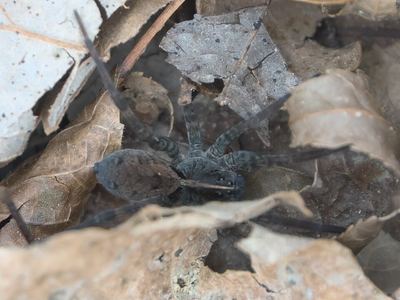
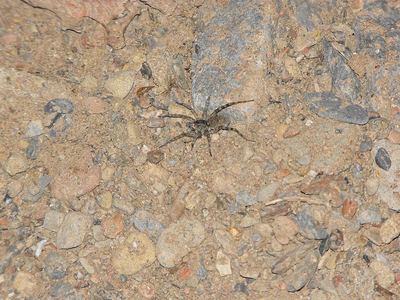
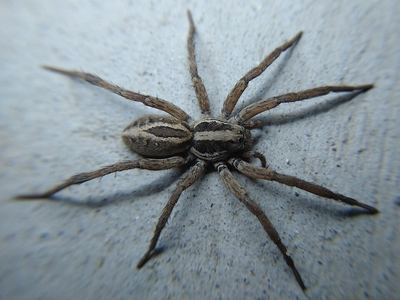
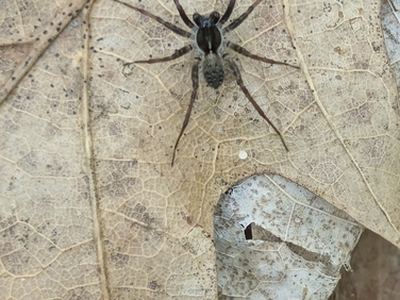
Dotted wolf spider (Rabidosa punctulata)
The dotted wolf spider is a spider in the family Lycosidae that is not dangerous to people. GBIF holds 391 licensed U.S. records of it; it reaches our listing threshold in 29 states, most of all Texas (106), Virginia (37) and North Carolina (29). Its observation records peak in October.
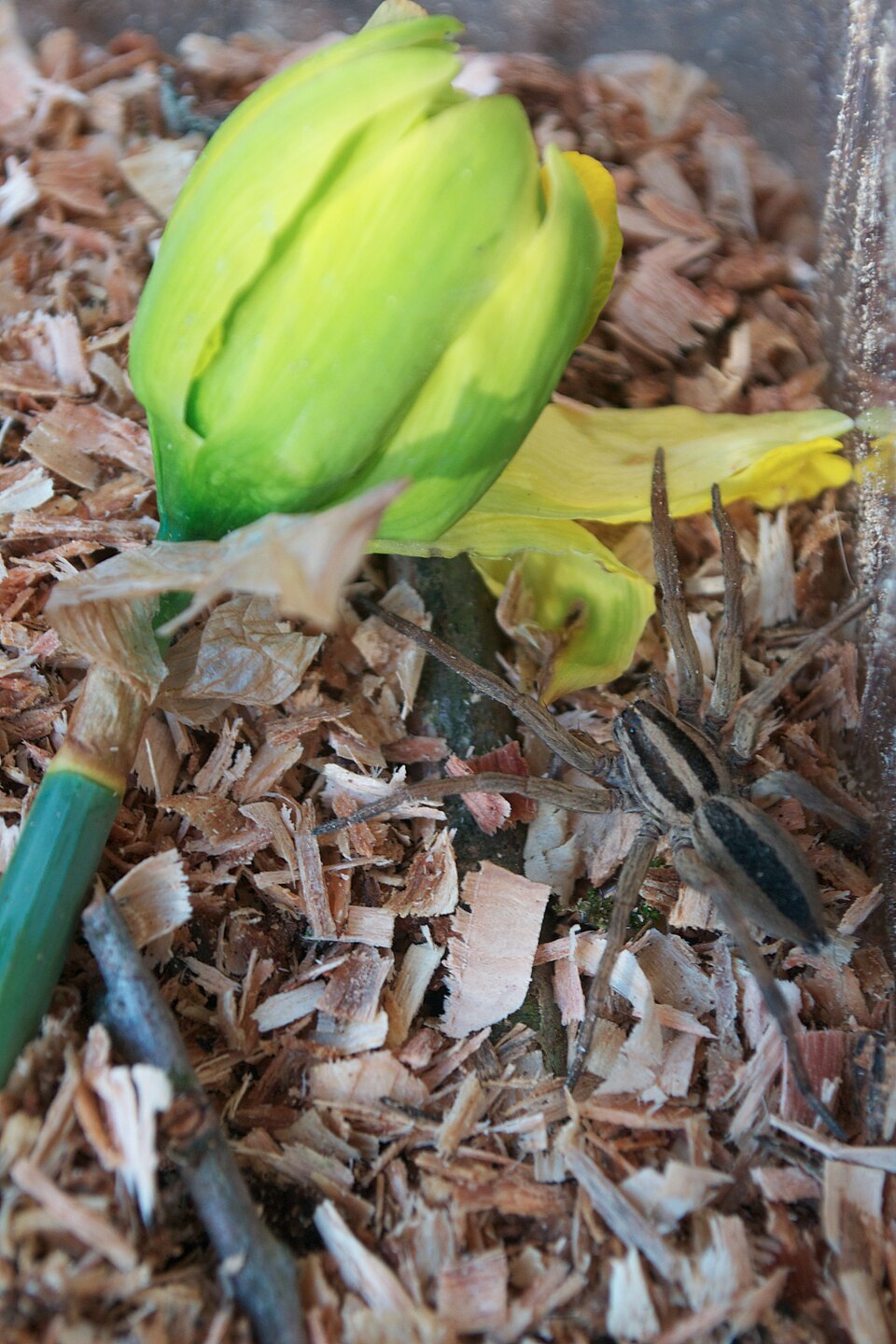

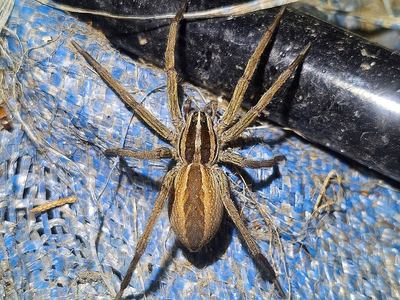
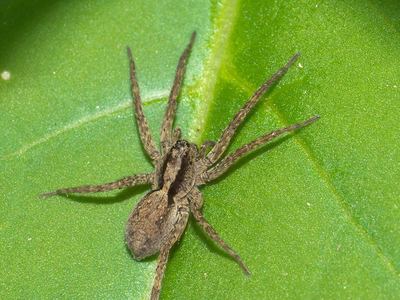
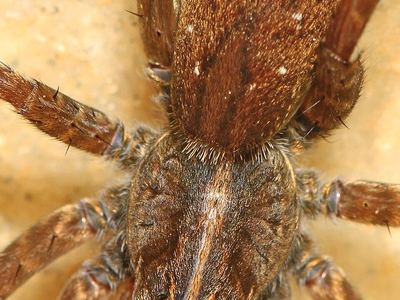
Rabidosa punctulata, the dotted wolf spider, is a species of spider in the family Lycosidae. It is found in areas of weeds and tall grasses. It is a light-brown and large wolf spider with stripes on the cephalothorax and an abdomen with light spots and a dark middle stripe.
From Wikipedia: Rabidosa punctulata, text under CC BY-SA 4.0.
Is the dotted wolf spider poisonous or venomous?
Not in any medically significant way. Like almost all spiders the dotted wolf spider (family Lycosidae) has venom for its prey, but it is not a widow or recluse, the two U.S. groups whose bites need medical attention.
Which states have the dotted wolf spider?
Records are spread over 29 states; the top three, Texas, Virginia and North Carolina, hold 44% of them.
| # | State | Records | Share of state spiders | Rank in state |
|---|---|---|---|---|
| 1 | Texas | 106 | 0.4% | 55th of 386 |
| 2 | Virginia | 37 | 0.3% | 62nd of 176 |
| 3 | North Carolina | 29 | 0.3% | 60th of 184 |
| 4 | Maryland | 20 | 0.4% | 63rd of 153 |
| 5 | Pennsylvania | 17 | 0.2% | 63rd of 164 |
| 6 | South Carolina | 16 | 0.7% | 32nd of 121 |
| 7 | Georgia | 15 | 0.2% | 76th of 186 |
| 8 | Mississippi | 14 | 1.0% | 23rd of 117 |
| 9 | Missouri | 14 | 0.6% | 36th of 117 |
| 10 | Illinois | 12 | 0.1% | 178th of 243 |
| 11 | Ohio | 12 | 0.2% | 79th of 332 |
| 12 | Oklahoma | 12 | 0.2% | 75th of 149 |
| 13 | Tennessee | 12 | 0.3% | 60th of 138 |
| 14 | Massachusetts | 11 | 0.2% | 72nd of 189 |
| 15 | Indiana | 9 | 0.2% | 93rd of 133 |
| 16 | Kentucky | 9 | 0.5% | 48th of 103 |
| 17 | Kansas | 7 | 0.4% | 45th of 94 |
| 18 | Arkansas | 6 | 0.4% | 66th of 114 |
| 19 | Louisiana | 6 | 0.1% | 75th of 107 |
| 20 | New Jersey | 6 | 0.3% | 69th of 127 |
| 21 | Florida | 4 | 0.0% | 198th of 237 |
| 22 | Alabama | 3 | 0.1% | 101st of 143 |
| 23 | Connecticut | 3 | 0.3% | 49th of 86 |
| 24 | Nebraska | 3 | 0.2% | 57th of 71 |
| 25 | Delaware | 2 | 0.1% | 66th of 71 |
| 26 | West Virginia | 2 | 0.3% | 48th of 90 |
| 27 | Michigan | 1 | 0.0% | 102nd of 122 |
| 28 | New York | 1 | 0.0% | 134th of 149 |
| 29 | Iowa | 0 | — | — |
When is the dotted wolf spider seen?
Across the U.S., observation records of the dotted wolf spider run mostly March through November, peaking in October with 24% of them. Winter (December to February) holds 9% of them.
Season by state
Among states whose main season falls within one calendar year, it starts earliest in March (Virginia) and latest in April (Texas). Each of these states peaks in a different month: October in Virginia and November in Texas.
| State | Main season | Peak month | Observation records |
|---|---|---|---|
| Texas | April through December | November | 104 |
| Virginia | March through October | October | 36 |
Where the dotted wolf spider is recorded in each state
Texas
Texas holds 106 licensed records, the 55th most recorded of 386 spiders listed there. Its observation records in Texas run mostly April through December, peaking in November; most licensed records come from Williamson County, Parker County and Travis County. Next come Tarrant County (5) and Collin County (5).
Virginia
Virginia holds 37 licensed records, the joint 62nd most recorded of 176 spiders listed there. Its observation records in Virginia run mostly March through October, peaking in October; most licensed records come from Fairfax County, Prince William County and Powhatan County. Next come Buckingham County (2) and Albemarle County (2).
Top counties in the U.S.
| # | County | State | Records | Share of U.S. |
|---|---|---|---|---|
| 1 | Williamson County | Texas | 12 | 3.1% |
| 2 | Parker County | Texas | 8 | 2.0% |
| 3 | Travis County | Texas | 6 | 1.5% |
| 4 | Fairfax County | Virginia | 6 | 1.5% |
| 5 | Tarrant County | Texas | 5 | 1.3% |
| 6 | Collin County | Texas | 5 | 1.3% |
| 7 | Prince William County | Virginia | 5 | 1.3% |
| 8 | Harris County | Texas | 4 | 1.0% |
| 9 | Baylor County | Texas | 4 | 1.0% |
| 10 | Rains County | Texas | 4 | 1.0% |
| 11 | Wilson County | Texas | 4 | 1.0% |
| 12 | Smith County | Texas | 3 | 0.8% |
| 13 | Brazos County | Texas | 3 | 0.8% |
| 14 | Dallas County | Texas | 3 | 0.8% |
| 15 | Fannin County | Texas | 3 | 0.8% |
How recent are the dotted wolf spider records?
Most of what is known about the dotted wolf spider is recent: 92% of dated U.S. records were made in 2017–2026, and half date from 2023 or later. The oldest dated record is from 1951; the busiest year was 2025, with 87 records.
| Decade | Records | Share |
|---|---|---|
| 1950s | 1 | 0.3% |
| 1960s | 5 | 1.3% |
| 1970s | 2 | 0.5% |
| 1980s | 1 | 0.3% |
| 1990s | 2 | 0.5% |
| 2000s | 4 | 1.0% |
| 2010s | 46 | 11.6% |
| 2020s | 337 | 84.7% |
Species recorded in the same counties
Of the 30 counties where the dotted wolf spider is most recorded, 18 are also top counties for the nursery web spider, more than for any other spider. None of its closest neighbors is venomous.
| Species | Shared counties |
|---|---|
| Nursery web spider | 18 |
| Dark fishing spider | 17 |
| Rabid wolf spider | 17 |
| Furrow orbweaver | 16 |
| Bronze jumper | 15 |
| Sylvan jumping spider | 15 |
| Black-and-yellow argiope | 14 |
| Familiar jumping spider | 14 |
Related species in the U.S.
Other species of the genus Rabidosa with profiles here: Rabid wolf spider.

GBIF records read 2026-09-29. Listed: any license. Counted: CC0/CC BY only. How we count.