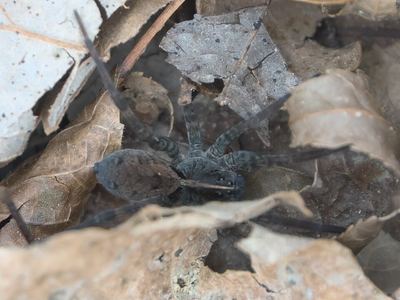
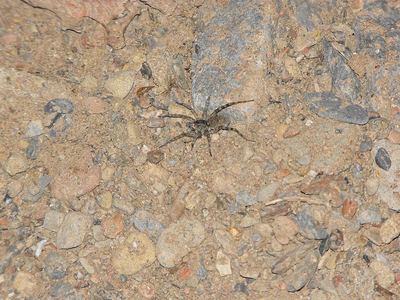
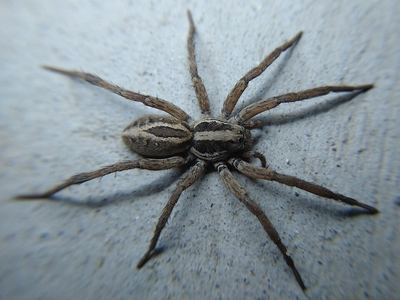
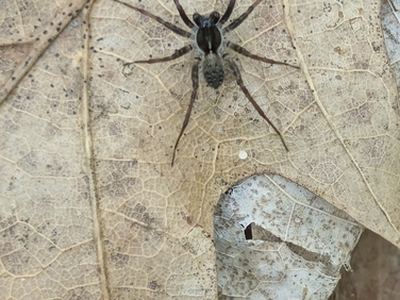
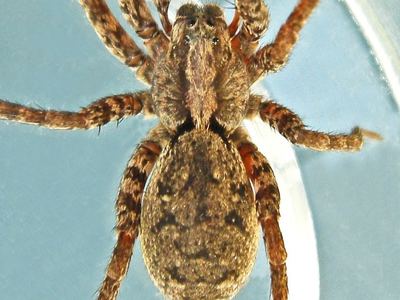
Brush-legged split wolf spider (Schizocosa ocreata)
The brush-legged split wolf spider is a spider in the family Lycosidae that is not dangerous to people. GBIF holds 508 licensed U.S. records of it; it reaches our listing threshold in 15 states, most of all Illinois (192), Indiana (29) and Florida (21). Its observation records peak in April.
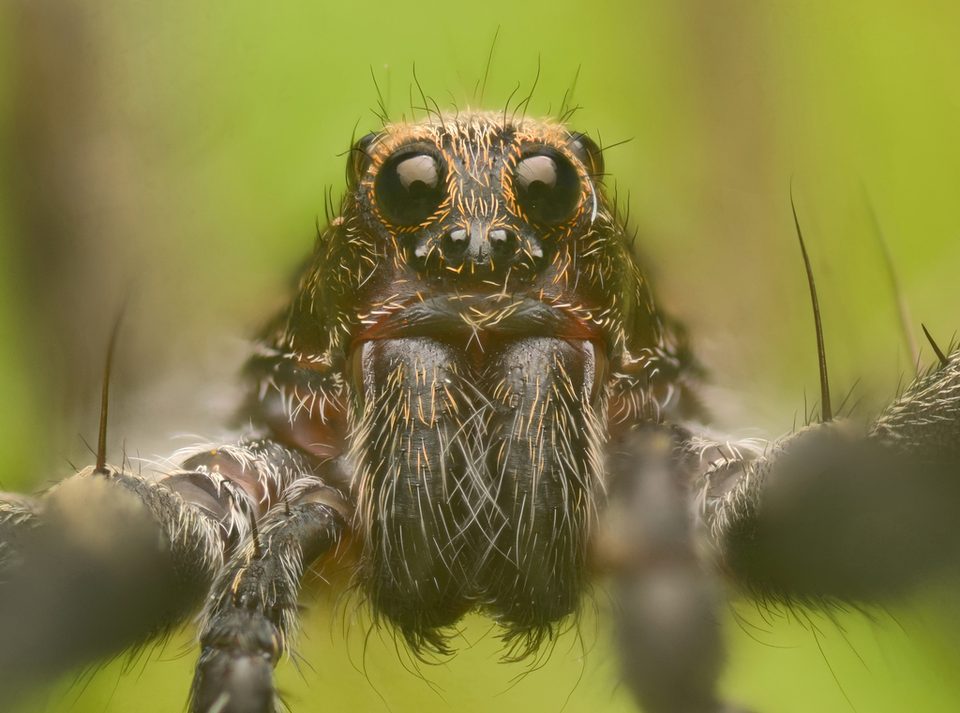
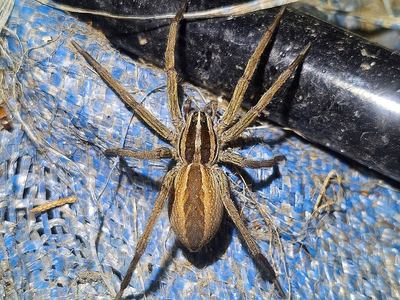
Schizocosa ocreata is a species of wolf spider in the family Lycosidae that is found in North America. The Schizocosa ocreata is a spider that is most commonly known as the “brush-legged wolf spider” because of the distinct dark-colored fur-like coverings around the front legs of males. The S. ocreata are commonly found in North American states, usually in the middle and eastern United States.
From Wikipedia: Schizocosa ocreata, text under CC BY-SA 4.0.
Is the brush-legged split wolf spider poisonous or venomous?
Not in any medically significant way. Like almost all spiders the brush-legged split wolf spider (family Lycosidae) has venom for its prey, but it is not a widow or recluse, the two U.S. groups whose bites need medical attention.
Which states have the brush-legged split wolf spider?
Records are spread over 15 states; the top three, Illinois, Indiana and Florida, hold 48% of them.
| # | State | Records | Share of state spiders | Rank in state |
|---|---|---|---|---|
| 1 | Illinois | 192 | 1.0% | 6th of 243 |
| 2 | Indiana | 29 | 0.7% | 32nd of 133 |
| 3 | Florida | 21 | 0.2% | 85th of 237 |
| 4 | Oklahoma | 20 | 0.4% | 51st of 149 |
| 5 | Virginia | 17 | 0.1% | 91st of 176 |
| 6 | Nebraska | 14 | 1.1% | 18th of 71 |
| 7 | Mississippi | 13 | 0.9% | 26th of 117 |
| 8 | Ohio | 9 | 0.1% | 92nd of 332 |
| 9 | North Carolina | 5 | 0.1% | 123rd of 184 |
| 10 | Wisconsin | 5 | 0.2% | 102nd of 149 |
| 11 | Georgia | 3 | 0.0% | 136th of 186 |
| 12 | Maryland | 3 | 0.1% | 123rd of 153 |
| 13 | Pennsylvania | 3 | 0.0% | 128th of 164 |
| 14 | South Carolina | 3 | 0.1% | 82nd of 121 |
| 15 | West Virginia | 0 | — | — |
When is the brush-legged split wolf spider seen?
Across the U.S., observation records of the brush-legged split wolf spider run mostly April through June, peaking in April with 39% of them. Almost none are from December to February.
How recent are the brush-legged split wolf spider records?
The brush-legged split wolf spider record leans on older material: only 25% of dated U.S. records come from 2017–2026, and the median record is from 2013. The oldest dated record is from 1926; the busiest year was 2014, with 45 records.
| Decade | Records | Share |
|---|---|---|
| 1920s | 5 | 1.3% |
| 1940s | 3 | 0.8% |
| 1950s | 1 | 0.3% |
| 1960s | 3 | 0.8% |
| 1970s | 5 | 1.3% |
| 1980s | 18 | 4.6% |
| 1990s | 17 | 4.3% |
| 2000s | 82 | 20.8% |
| 2010s | 205 | 51.9% |
| 2020s | 56 | 14.2% |
Species recorded in the same counties
Of the 15 counties where the brush-legged split wolf spider is most recorded, 12 are also top counties for both Phrurotimpus alarius and the tan crab spider; no other spider shares more. None of its closest neighbors is venomous.
| Species | Shared counties |
|---|---|
| Phrurotimpus alarius | 12 |
| Tan crab spider | 12 |
| Autumn money spider | 9 |
| Greater ant-mimic corinne spider | 9 |
| Piratula minuta | 9 |
| Common white-cheeked jumping spider | 8 |
| Nursery web spider | 8 |
| Pale sheetweb weaver | 8 |
Related species in the U.S.
Other species of the genus Schizocosa with profiles here: McCook's split wolf spider.
GBIF records read 2026-09-29. Listed: any license. Counted: CC0/CC BY only. How we count.