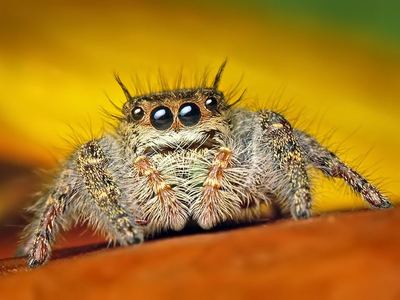
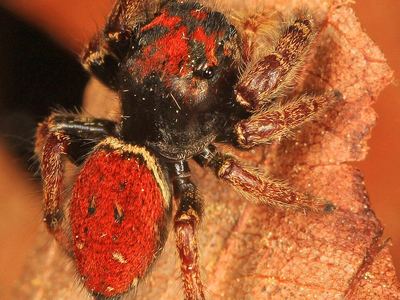
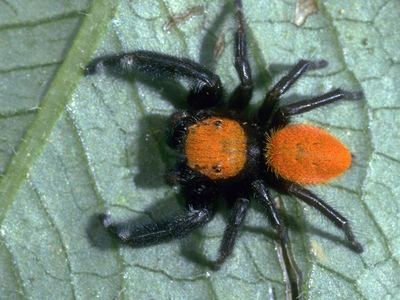
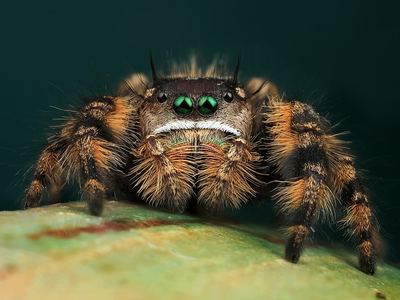
Brilliant jumping spider (Phidippus clarus)
The brilliant jumping spider is a spider in the family Salticidae that is not dangerous to people. GBIF holds 1,226 licensed U.S. records of it; it reaches our listing threshold in 45 states, most of all Illinois (139), Georgia (92) and Virginia (87). Its observation records peak in July.
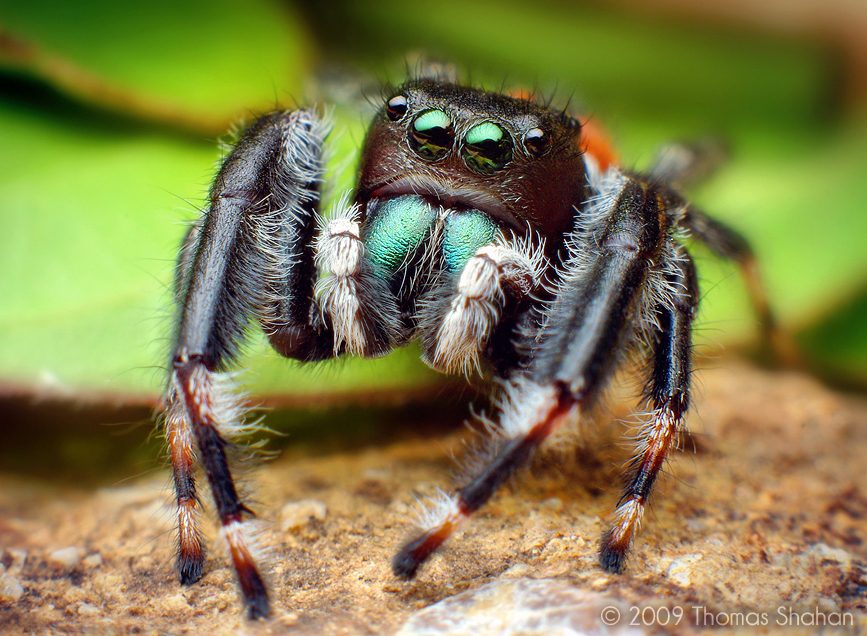

Phidippus clarus, also known as the brilliant jumping spider, is a species of jumping spider (family Salticidae) found in old fields throughout eastern North America. It often waits upside down near the top of a plant, which may be useful for detecting prey, and then quickly jumps down before the prey can escape. The spider is one of 60 species in the genus Phidippus, and one of about 5,000 in the Salticidae, a family that accounts for about 10% of all spider species.
From Wikipedia: Phidippus clarus, text under CC BY-SA 4.0.
Is the brilliant jumping spider poisonous or venomous?
Not in any medically significant way. Like almost all spiders the brilliant jumping spider (family Salticidae) has venom for its prey, but it is not a widow or recluse, the two U.S. groups whose bites need medical attention.
Which states have the brilliant jumping spider?
Records are spread over 45 states; the top three, Illinois, Georgia and Virginia, hold 26% of them.
| # | State | Records | Share of state spiders | Rank in state |
|---|---|---|---|---|
| 1 | Illinois | 139 | 0.7% | 14th of 243 |
| 2 | Georgia | 92 | 1.4% | 19th of 186 |
| 3 | Virginia | 87 | 0.8% | 32nd of 176 |
| 4 | North Carolina | 77 | 0.9% | 29th of 184 |
| 5 | Texas | 64 | 0.2% | 87th of 386 |
| 6 | Maryland | 53 | 0.9% | 29th of 153 |
| 7 | Oklahoma | 46 | 0.9% | 24th of 149 |
| 8 | Minnesota | 41 | 1.4% | 18th of 145 |
| 9 | Ohio | 40 | 0.6% | 43rd of 332 |
| 10 | Florida | 39 | 0.3% | 48th of 237 |
| 11 | Missouri | 37 | 1.6% | 14th of 117 |
| 12 | New Hampshire | 37 | 2.7% | 10th of 72 |
| 13 | Massachusetts | 35 | 0.8% | 30th of 189 |
| 14 | Delaware | 29 | 1.4% | 18th of 71 |
| 15 | Wisconsin | 29 | 0.9% | 23rd of 149 |
| 16 | New York | 28 | 0.5% | 47th of 149 |
| 17 | Kansas | 27 | 1.6% | 11th of 94 |
| 18 | Vermont | 27 | 1.7% | 13th of 74 |
| 19 | Arkansas | 26 | 1.6% | 18th of 114 |
| 20 | Tennessee | 26 | 0.7% | 40th of 138 |
| 21 | Pennsylvania | 24 | 0.3% | 50th of 164 |
| 22 | Michigan | 22 | 0.9% | 26th of 122 |
| 23 | South Carolina | 20 | 0.8% | 27th of 121 |
| 24 | Colorado | 19 | 0.5% | 26th of 378 |
| 25 | Oregon | 19 | 0.7% | 25th of 88 |
| 26 | Kentucky | 18 | 1.0% | 29th of 103 |
| 27 | Mississippi | 16 | 1.1% | 19th of 117 |
| 28 | Alabama | 15 | 0.4% | 59th of 143 |
| 29 | Indiana | 14 | 0.3% | 65th of 133 |
| 30 | Iowa | 11 | 1.6% | 13th of 57 |
| 31 | Louisiana | 10 | 0.2% | 61st of 107 |
| 32 | California | 8 | 0.0% | 239th of 309 |
| 33 | Maine | 8 | 0.9% | 28th of 297 |
| 34 | New Jersey | 8 | 0.4% | 59th of 127 |
| 35 | West Virginia | 6 | 0.8% | 27th of 90 |
| 36 | South Dakota | 5 | 2.6% | 7th of 29 |
| 37 | Connecticut | 4 | 0.4% | 42nd of 86 |
| 38 | Montana | 4 | 0.2% | 42nd of 75 |
| 39 | Washington | 4 | 0.1% | 81st of 157 |
| 40 | Idaho | 3 | 0.6% | 26th of 56 |
| 41 | Utah | 3 | 0.1% | 58th of 97 |
| 42 | Nebraska | 2 | 0.2% | 66th of 71 |
| 43 | New Mexico | 2 | 0.1% | 125th of 247 |
| 44 | Rhode Island | 1 | 0.6% | 29th of 53 |
| 45 | North Dakota | 0 | — | — |
When is the brilliant jumping spider seen?
Across the U.S., observation records of the brilliant jumping spider run mostly May through August, peaking in July with 33% of them. Almost none are from December to February.
Season by state
Among states whose main season falls within one calendar year, it starts earliest in April (North Carolina and Texas) and latest in June (Illinois, Maryland and Ohio). The most common peak month is June, shared by New Hampshire, Ohio, Oklahoma and Virginia.
| State | Main season | Peak month | Observation records |
|---|---|---|---|
| Georgia | May through September | August | 92 |
| Virginia | May through September | June | 87 |
| North Carolina | April through September | August | 77 |
| Texas | April through August | July | 63 |
| Maryland | June through August | August | 53 |
| Oklahoma | May through August | June | 43 |
| Minnesota | concentrated in June and July | — | 41 |
| Ohio | June through August | June | 40 |
| Illinois | June through August | July | 39 |
| New Hampshire | May through July | June | 37 |
| Missouri | May through July | July | 36 |
| Massachusetts | concentrated in June and July | — | 35 |
Where the brilliant jumping spider is recorded in each state
Illinois
Illinois holds 139 licensed records, the joint 14th most recorded of 243 spiders listed there. Its observation records in Illinois run mostly June through August, peaking in July; most licensed records come from Champaign County, Iroquois County and Cook County. Next come Lake County (7) and Jo Daviess County (5).
Georgia
Georgia holds 92 licensed records, the 19th most recorded of 186 spiders listed there. Its observation records in Georgia run mostly May through September, peaking in August; most licensed records come from Clarke County, Jones County and Oconee County. Next come Rockdale County (4) and Cherokee County (4).
Virginia
Virginia holds 87 licensed records, the joint 32nd most recorded of 176 spiders listed there. Its observation records in Virginia run mostly May through September, peaking in June; most licensed records come from Fairfax County, Hanover County and Prince William County. Next come Chesterfield County (4) and Albemarle County (4).
North Carolina
North Carolina holds 77 licensed records, the 29th most recorded of 184 spiders listed there. Its observation records in North Carolina run mostly April through September, peaking in August; most licensed records come from Cumberland County, Durham County and Wake County. Next come Cabarrus County (5) and Orange County (5).
Texas
Texas holds 64 licensed records, the 87th most recorded of 386 spiders listed there. Its observation records in Texas run mostly April through August, peaking in July; most licensed records come from Erath County, Dallas County and Tarrant County. Next come Brazos County (3) and Denton County (3).
Maryland
Maryland holds 53 licensed records, the joint 29th most recorded of 153 spiders listed there. Its observation records in Maryland run mostly June through August, peaking in August; most licensed records come from Prince George's County, Baltimore County and Frederick County. Next come Carroll County (6) and Montgomery County (4).
Oklahoma
Oklahoma holds 46 licensed records, the joint 24th most recorded of 149 spiders listed there. Its observation records in Oklahoma run mostly May through August, peaking in June; most licensed records come from Mayes County, Osage County and Carter County. Next come Cleveland County (2) and Comanche County (2).
Minnesota
Minnesota holds 41 licensed records, the 18th most recorded of 145 spiders listed there. Its observation records in Minnesota are concentrated in June and July (93% of them); most licensed records come from Hennepin County, Ramsey County and Dakota County. Next come Anoka County (2) and Mower County (2).
Ohio
Ohio holds 40 licensed records, the 43rd most recorded of 332 spiders listed there. Its observation records in Ohio run mostly June through August, peaking in June; most licensed records come from Montgomery County, Clark County and Clermont County. Next come Franklin County (3) and Hamilton County (3).
Florida
Florida holds 39 licensed records, the joint 48th most recorded of 237 spiders listed there. Most of its licensed records in Florida come from Okeechobee County, Hillsborough County and Orange County. Next come Collier County (3) and Osceola County (3).
Missouri
Missouri holds 37 licensed records, the 14th most recorded of 117 spiders listed there. Its observation records in Missouri run mostly May through July, peaking in July; most licensed records come from Adair County, DeKalb County and Texas County. Next come Platte County (3) and Jackson County (2).
New Hampshire
New Hampshire holds 37 licensed records, the joint 10th most recorded of 72 spiders listed there. Its observation records in New Hampshire run mostly May through July, peaking in June; most licensed records come from Hillsborough County, Rockingham County and Sullivan County. Next come Cheshire County (3) and Grafton County (3).
Massachusetts
Massachusetts holds 35 licensed records, the joint 30th most recorded of 189 spiders listed there. Its observation records in Massachusetts are concentrated in June and July (94% of them); most licensed records come from Barnstable County, Plymouth County and Worcester County. Next come Dukes County (4) and Middlesex County (4).
Top counties in the U.S.
| # | County | State | Records | Share of U.S. |
|---|---|---|---|---|
| 1 | Clarke County | Georgia | 48 | 3.9% |
| 2 | Champaign County | Illinois | 43 | 3.5% |
| 3 | Iroquois County | Illinois | 30 | 2.4% |
| 4 | Hillsborough County | New Hampshire | 20 | 1.6% |
| 5 | Cook County | Illinois | 17 | 1.4% |
| 6 | Erath County | Texas | 16 | 1.3% |
| 7 | Cumberland County | North Carolina | 15 | 1.2% |
| 8 | Fairfax County | Virginia | 15 | 1.2% |
| 9 | Hanover County | Virginia | 15 | 1.2% |
| 10 | Prince George's County | Maryland | 14 | 1.1% |
| 11 | Prince William County | Virginia | 14 | 1.1% |
| 12 | Dallas County | Texas | 13 | 1.1% |
| 13 | Mayes County | Oklahoma | 11 | 0.9% |
| 14 | Osage County | Oklahoma | 11 | 0.9% |
| 15 | Barnstable County | Massachusetts | 9 | 0.7% |
How recent are the brilliant jumping spider records?
Most of what is known about the brilliant jumping spider is recent: 86% of dated U.S. records were made in 2017–2026, and half date from 2022 or later. The oldest dated record is from 1912; the busiest year was 2025, with 189 records.
| Decade | Records | Share |
|---|---|---|
| 1910s | 1 | 0.1% |
| 1920s | 2 | 0.2% |
| 1930s | 6 | 0.5% |
| 1940s | 9 | 0.7% |
| 1950s | 7 | 0.6% |
| 1960s | 12 | 1.0% |
| 1970s | 2 | 0.2% |
| 1980s | 3 | 0.2% |
| 1990s | 72 | 5.7% |
| 2000s | 3 | 0.2% |
| 2010s | 171 | 13.6% |
| 2020s | 971 | 77.1% |
Species recorded in the same counties
Of the 177 counties where the brilliant jumping spider is most recorded, 103 are also top counties for the black-and-yellow argiope, more than for any other spider. None of its closest neighbors is venomous.
| Species | Shared counties |
|---|---|
| Black-and-yellow argiope | 103 |
| Bold jumper | 95 |
| Familiar jumping spider | 88 |
| Nursery web spider | 86 |
| Spotted orbweaver | 86 |
| Whitebanded crab spider | 86 |
| Rabid wolf spider | 84 |
| Arabesque orbweaver | 76 |
Related species in the U.S.
Other species of the genus Phidippus with profiles here: Bold jumper, Putnam's jumper, Johnson jumper, Grayish jumping spider, Whitman's jumping spider, Apache jumping spider and Canopy jumping spider.
GBIF records read 2026-09-29. Listed: any license. Counted: CC0/CC BY only. How we count.