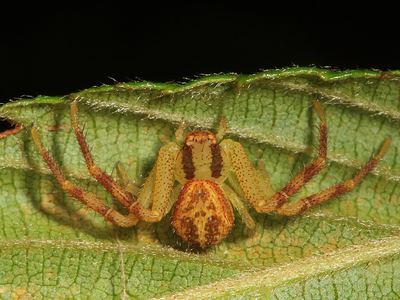
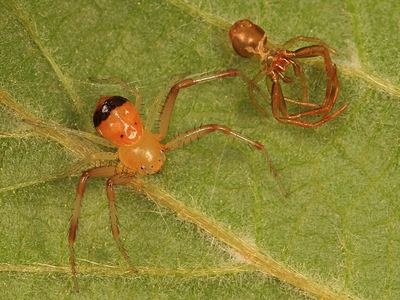
Celer crab spider (Mecaphesa celer)
The celer crab spider is a spider in the family Thomisidae that is not dangerous to people. GBIF holds 358 licensed U.S. records of it; it reaches our listing threshold in 17 states, most of all Texas (124), Oklahoma (66) and Florida (39). Its observation records peak in April.
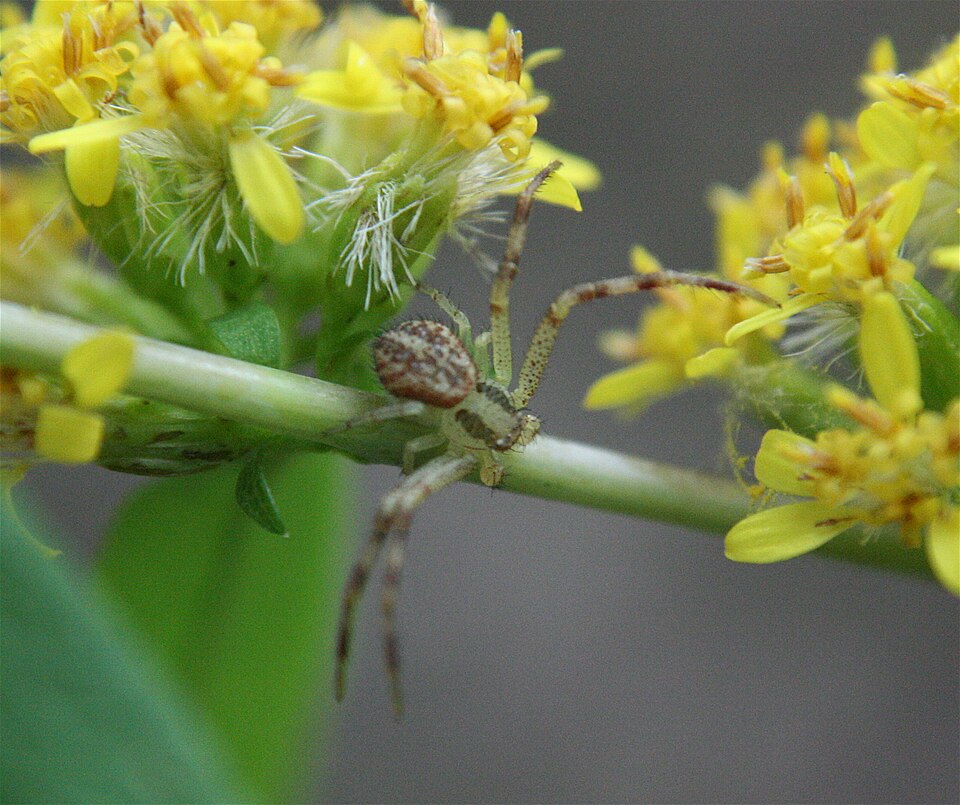

Mecaphesa celer, known generally as the swift crab spider, is a species of crab spider in the family Thomisidae. Its range is quite large, and it is found throughout much of North and Central America. M. celer are sit-and-wait predators who hide out on the flowers and upper stalks of plants, waiting for prey to pass by.
From Wikipedia: Mecaphesa celer, text under CC BY-SA 4.0.
Is the celer crab spider poisonous or venomous?
Not in any medically significant way. Like almost all spiders the celer crab spider (family Thomisidae) has venom for its prey, but it is not a widow or recluse, the two U.S. groups whose bites need medical attention.
Which states have the celer crab spider?
Records are spread over 17 states; the top three, Texas, Oklahoma and Florida, hold 64% of them.
| # | State | Records | Share of state spiders | Rank in state |
|---|---|---|---|---|
| 1 | Texas | 124 | 0.4% | 48th of 386 |
| 2 | Oklahoma | 66 | 1.3% | 18th of 149 |
| 3 | Florida | 39 | 0.3% | 48th of 237 |
| 4 | New Mexico | 15 | 0.6% | 23rd of 247 |
| 5 | Mississippi | 14 | 1.0% | 23rd of 117 |
| 6 | North Carolina | 10 | 0.1% | 89th of 184 |
| 7 | Minnesota | 8 | 0.3% | 66th of 145 |
| 8 | Nebraska | 5 | 0.4% | 47th of 71 |
| 9 | Missouri | 4 | 0.2% | 69th of 117 |
| 10 | Georgia | 3 | 0.0% | 136th of 186 |
| 11 | Kansas | 3 | 0.2% | 67th of 94 |
| 12 | Alabama | 2 | 0.1% | 107th of 143 |
| 13 | Colorado | 2 | 0.0% | 117th of 378 |
| 14 | South Carolina | 1 | 0.0% | 104th of 121 |
| 15 | South Dakota | 1 | 0.5% | 22nd of 29 |
| 16 | Virginia | 1 | 0.0% | 167th of 176 |
| 17 | Wyoming | 0 | — | — |
When is the celer crab spider seen?
Across the U.S., observation records of the celer crab spider run mostly March through August, peaking in April with 30% of them. Almost none are from December to February.
Where the celer crab spider is recorded in each state
Texas
Texas holds 124 licensed records, the 48th most recorded of 386 spiders listed there. Its observation records in Texas run mostly March through July, peaking in April; most licensed records come from Dallas County, Collin County and Travis County. Next come Denton County (11) and Tarrant County (10).
Oklahoma
Oklahoma holds 66 licensed records, the 18th most recorded of 149 spiders listed there. Most of its licensed records in Oklahoma come from Comanche County, Marshall County and Mayes County. Next come Tulsa County (6) and Oklahoma County (3).
Florida
Florida holds 39 licensed records, the joint 48th most recorded of 237 spiders listed there. Most of its licensed records in Florida come from Okeechobee County, Escambia County and Orange County. Next come Sarasota County (3) and Highlands County (1).
Top counties in the U.S.
| # | County | State | Records | Share of U.S. |
|---|---|---|---|---|
| 1 | Pima County | Arizona | 30 | 8.4% |
| 2 | Dallas County | Texas | 27 | 7.5% |
| 3 | Comanche County | Oklahoma | 24 | 6.7% |
| 4 | Marshall County | Oklahoma | 18 | 5.0% |
| 5 | Collin County | Texas | 14 | 3.9% |
| 6 | Travis County | Texas | 12 | 3.4% |
| 7 | Okeechobee County | Florida | 11 | 3.1% |
| 8 | Denton County | Texas | 11 | 3.1% |
| 9 | Escambia County | Florida | 10 | 2.8% |
| 10 | Tarrant County | Texas | 10 | 2.8% |
| 11 | Mayes County | Oklahoma | 7 | 2.0% |
| 12 | Galveston County | Texas | 7 | 2.0% |
| 13 | Yavapai County | Arizona | 6 | 1.7% |
| 14 | Coconino County | Arizona | 6 | 1.7% |
| 15 | Orange County | Florida | 6 | 1.7% |
How recent are the celer crab spider records?
Records of the celer crab spider span old collections and new observations: 48% date from 2017–2026, and the median record is from 2013. The oldest dated record is from 1926; the busiest year was 2011, with 52 records.
| Decade | Records | Share |
|---|---|---|
| 1920s | 24 | 6.6% |
| 1930s | 3 | 0.8% |
| 1940s | 2 | 0.6% |
| 1960s | 2 | 0.6% |
| 1980s | 11 | 3.0% |
| 1990s | 5 | 1.4% |
| 2000s | 47 | 13.0% |
| 2010s | 101 | 28.0% |
| 2020s | 166 | 46.0% |
Species recorded in the same counties
Of the 44 counties where the celer crab spider is most recorded, 23 are also top counties for the green lynx spider, more than for any other spider. None of its closest neighbors is venomous.
| Species | Shared counties |
|---|---|
| Green lynx spider | 23 |
| Rabid wolf spider | 22 |
| Striped lynx spider | 22 |
| Familiar jumping spider | 21 |
| Shoreline wolf spider | 20 |
| Spotted orbweaver | 19 |
| Sylvan jumping spider | 19 |
| Black-and-yellow argiope | 18 |
Related species in the U.S.
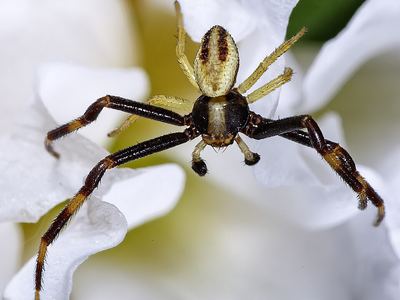
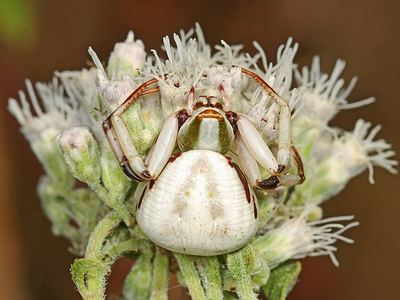
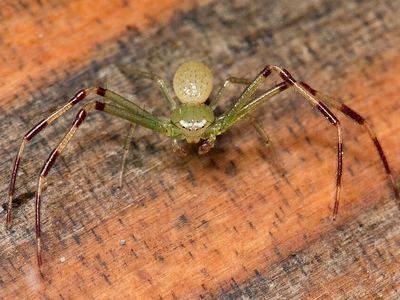
Other species of the genus Mecaphesa with profiles here: Flower crab spider.
GBIF records read 2026-09-29. Listed: any license. Counted: CC0/CC BY only. How we count.