Green lynx spider (Peucetia viridans)
The green lynx spider is a spider in the family Oxyopidae that is not dangerous to people. GBIF holds 2,985 licensed U.S. records of it; it reaches our listing threshold in 16 states, most of all Texas (864), Florida (509) and California (371). Its observation records peak in September.
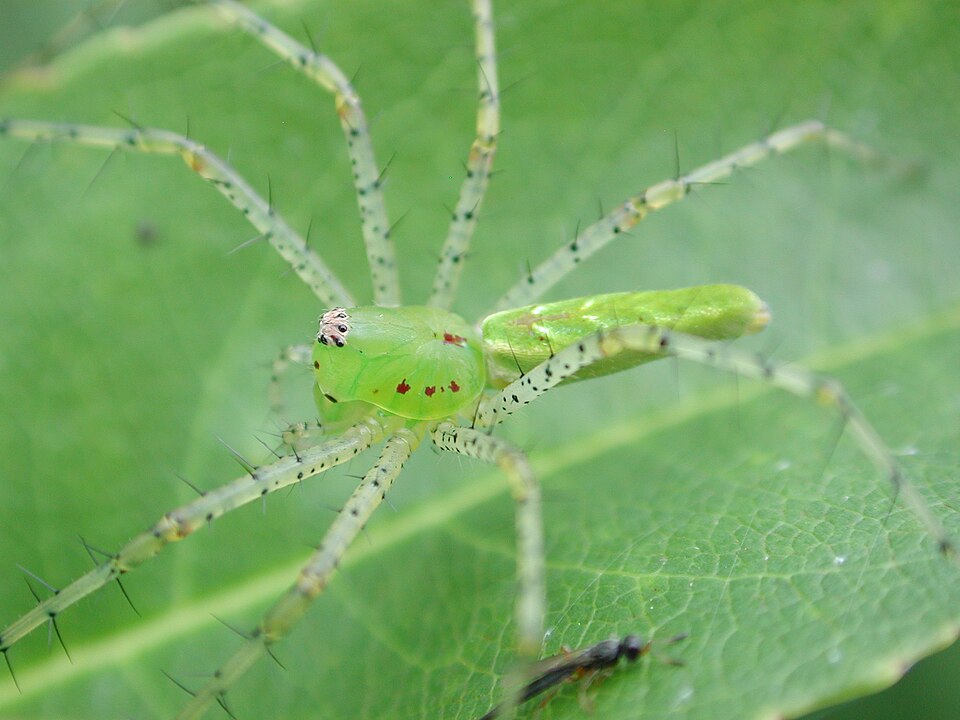
Peucetia viridans, the green lynx spider, is a bright-green lynx spider usually found on green plants. This spider is common in the southern U.S., Mexico, Central America, and in many West Indies islands, especially Jamaica. Lynx spiders are hunters specialized for living on plants.
From Wikipedia: Peucetia viridans, text under CC BY-SA 4.0.
Is the green lynx spider poisonous or venomous?
Not in any medically significant way. Like almost all spiders the green lynx spider (family Oxyopidae) has venom for its prey, but it is not a widow or recluse, the two U.S. groups whose bites need medical attention.
Which states have the green lynx spider?
Records are spread over 16 states; the top three, Texas, Florida and California, hold 58% of them. It is the most recorded spider of all in Mississippi.
| # | State | Records | Share of state spiders | Rank in state |
|---|---|---|---|---|
| 1 | Texas | 864 | 3.0% | 4th of 386 |
| 2 | Florida | 509 | 4.1% | 5th of 237 |
| 3 | California | 371 | 0.7% | 23rd of 309 |
| 4 | Georgia | 309 | 4.6% | 3rd of 186 |
| 5 | North Carolina | 220 | 2.6% | 5th of 184 |
| 6 | Alabama | 149 | 4.1% | 4th of 143 |
| 7 | Mississippi | 95 | 6.7% | 1st of 117 |
| 8 | Louisiana | 94 | 2.3% | 11th of 107 |
| 9 | Oklahoma | 93 | 1.8% | 9th of 149 |
| 10 | Arizona | 73 | 1.6% | 6th of 162 |
| 11 | Tennessee | 65 | 1.7% | 14th of 138 |
| 12 | South Carolina | 63 | 2.6% | 7th of 121 |
| 13 | Arkansas | 45 | 2.8% | 6th of 114 |
| 14 | Virginia | 25 | 0.2% | 76th of 176 |
| 15 | New Mexico | 5 | 0.2% | 84th of 247 |
| 16 | Missouri | 1 | 0.0% | 101st of 117 |
When is the green lynx spider seen?
Across the U.S., observation records of the green lynx spider run mostly May through November, peaking in September with 21% of them. Winter (December to February) holds 3% of them.
Season by state
Among states whose main season falls within one calendar year, it starts earliest in April (Arizona and California) and latest in June (Arkansas, Georgia, Louisiana, Mississippi, North Carolina, South Carolina and Tennessee). The most common peak month is September, shared by Arizona, Arkansas, California, Georgia, Mississippi, South Carolina and Texas.
| State | Main season | Peak month | Observation records |
|---|---|---|---|
| Texas | May through November | September | 840 |
| Florida | May through December | October | 470 |
| California | April through October | September | 345 |
| Georgia | June through October | September | 307 |
| North Carolina | June through October | August | 220 |
| Alabama | May through October | August | 145 |
| Oklahoma | May through October | July | 82 |
| Mississippi | June through October | September | 75 |
| Tennessee | June through September | August | 65 |
| Arizona | April through October | September | 64 |
| South Carolina | June through October | September | 63 |
| Louisiana | June through October | August | 57 |
| Arkansas | June through October | September | 43 |
Where the green lynx spider is recorded in each state
Texas
Texas holds 864 licensed records, the 4th most recorded of 386 spiders listed there. Its observation records in Texas run mostly May through November, peaking in September; most licensed records come from Hidalgo County, Travis County and Bexar County. Next come Tarrant County (38) and Dallas County (38).
Florida
Florida holds 509 licensed records, the 5th most recorded of 237 spiders listed there. Its observation records in Florida run mostly May through December, peaking in October; most licensed records come from Orange County, Alachua County and Broward County. Next come Seminole County (23) and Polk County (20).
California
California holds 371 licensed records, the 23rd most recorded of 309 spiders listed there. Its observation records in California run mostly April through October, peaking in September; most licensed records come from San Diego County, Santa Barbara County and Los Angeles County. Next come Santa Clara County (15) and Riverside County (14).
Georgia
Georgia holds 309 licensed records, the 3rd most recorded of 186 spiders listed there. Its observation records in Georgia run mostly June through October, peaking in September; most licensed records come from Clarke County, DeKalb County and Laurens County. Next come Jones County (27) and Gwinnett County (13).
North Carolina
North Carolina holds 220 licensed records, the 5th most recorded of 184 spiders listed there. Its observation records in North Carolina run mostly June through October, peaking in August; most licensed records come from Orange County, Cumberland County and Mecklenburg County. Next come Durham County (20) and Wake County (20).
Alabama
Alabama holds 149 licensed records, the 4th most recorded of 143 spiders listed there. Its observation records in Alabama run mostly May through October, peaking in August; most licensed records come from Blount County, Jefferson County and Marshall County. Next come Baldwin County (6) and Limestone County (6).
Mississippi
Mississippi holds 95 licensed records, the most recorded of 117 spiders listed there. Its observation records in Mississippi run mostly June through October, peaking in September; most licensed records come from Jackson County, Oktibbeha County and Perry County. Next come Simpson County (9) and Stone County (5).
Louisiana
Louisiana holds 94 licensed records, the 11th most recorded of 107 spiders listed there. Its observation records in Louisiana run mostly June through October, peaking in August; most licensed records come from Vernon Parish, Saint Tammany Parish and Natchitoches Parish. Next come Rapides Parish (10) and East Baton Rouge Parish (8).
Oklahoma
Oklahoma holds 93 licensed records, the 9th most recorded of 149 spiders listed there. Its observation records in Oklahoma run mostly May through October, peaking in July; most licensed records come from Mayes County, Cleveland County and Marshall County. Next come Osage County (9) and Bryan County (4).
Arizona
Arizona holds 73 licensed records, the 6th most recorded of 162 spiders listed there. Its observation records in Arizona run mostly April through October, peaking in September; most licensed records come from Pima County, Santa Cruz County and Maricopa County. Next come Cochise County (4) and Yavapai County (3).
Tennessee
Tennessee holds 65 licensed records, the 14th most recorded of 138 spiders listed there. Its observation records in Tennessee run mostly June through September, peaking in August; most licensed records come from Knox County, Blount County and Williamson County. Next come Rutherford County (6) and Davidson County (5).
South Carolina
South Carolina holds 63 licensed records, the 7th most recorded of 121 spiders listed there. Its observation records in South Carolina run mostly June through October, peaking in September; most licensed records come from Lexington County, Greenville County and Charleston County. Next come Horry County (3) and Richland County (3).
Arkansas
Arkansas holds 45 licensed records, the 6th most recorded of 114 spiders listed there. Its observation records in Arkansas run mostly June through October, peaking in September; most licensed records come from Johnson County, Faulkner County and Craighead County. Next come Clark County (2) and Howard County (2).
Top counties in the U.S.
| # | County | State | Records | Share of U.S. |
|---|---|---|---|---|
| 1 | San Diego County | California | 171 | 5.7% |
| 2 | Orange County | Florida | 106 | 3.6% |
| 3 | Clarke County | Georgia | 95 | 3.2% |
| 4 | Alachua County | Florida | 81 | 2.7% |
| 5 | Hidalgo County | Texas | 81 | 2.7% |
| 6 | Santa Barbara County | California | 77 | 2.6% |
| 7 | Travis County | Texas | 71 | 2.4% |
| 8 | Blount County | Alabama | 58 | 1.9% |
| 9 | Pima County | Arizona | 49 | 1.6% |
| 10 | Los Angeles County | California | 46 | 1.5% |
| 11 | Broward County | Florida | 40 | 1.3% |
| 12 | Jackson County | Mississippi | 40 | 1.3% |
| 13 | Bexar County | Texas | 40 | 1.3% |
| 14 | Tarrant County | Texas | 38 | 1.3% |
| 15 | Dallas County | Texas | 38 | 1.3% |
How recent are the green lynx spider records?
Most of what is known about the green lynx spider is recent: 88% of dated U.S. records were made in 2017–2026, and half date from 2022 or later. The oldest dated record is from 1936; the busiest year was 2022, with 367 records.
| Decade | Records | Share |
|---|---|---|
| 1930s | 1 | 0.0% |
| 1970s | 4 | 0.1% |
| 1980s | 12 | 0.4% |
| 1990s | 5 | 0.2% |
| 2000s | 57 | 1.9% |
| 2010s | 657 | 22.2% |
| 2020s | 2,224 | 75.1% |
Species recorded in the same counties
Of the 186 counties where the green lynx spider is most recorded, 101 are also top counties for the black-and-yellow argiope, more than for any other spider. None of its closest neighbors is venomous.
| Species | Shared counties |
|---|---|
| Black-and-yellow argiope | 101 |
| Spotted orbweaver | 98 |
| Rabid wolf spider | 83 |
| Familiar jumping spider | 79 |
| Bold jumper | 69 |
| Magnolia green jumper | 68 |
| Sylvan jumping spider | 66 |
| Twin-flagged jumping spider | 65 |
Related species in the U.S.
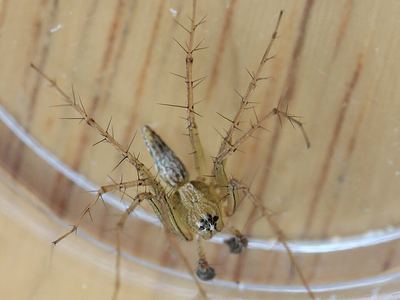
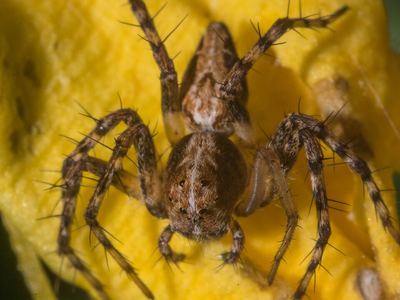
Other members of the family Oxyopidae with profiles here: Striped lynx spider and Western lynx spider.

GBIF records read 2026-09-29. Listed: any license. Counted: CC0/CC BY only. How we count.