Red-femured spotted orbweaver (Neoscona domiciliorum)
The red-femured spotted orbweaver is a spider in the family Araneidae that is not dangerous to people. GBIF holds 579 licensed U.S. records of it; it reaches our listing threshold in 22 states, most of all Florida (121), North Carolina (111) and Georgia (97). Its observation records peak in September.
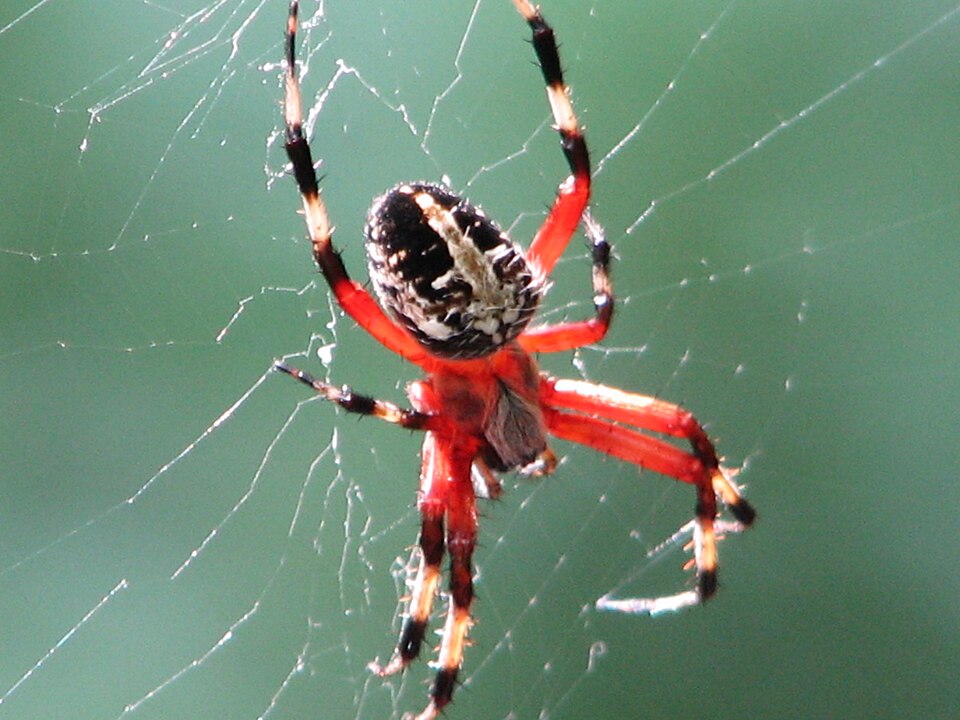

Neoscona domiciliorum, commonly known as the spotted orbweaver or redfemured spotted orbweaver, is a spider in the family Araneidae. The specific epithet domiciliorum means "of dwellings" in Latin and refers to the fact that this species is often found living on buildings. Their bites are not known to cause serious harm in humans.
From Wikipedia: Neoscona domiciliorum, text under CC BY-SA 4.0.
Is the red-femured spotted orbweaver poisonous or venomous?
Not in any medically significant way. Like almost all spiders the red-femured spotted orbweaver (family Araneidae) has venom for its prey, but it is not a widow or recluse, the two U.S. groups whose bites need medical attention.
Which states have the red-femured spotted orbweaver?
Records are spread over 22 states; the top three, Florida, North Carolina and Georgia, hold 57% of them.
| # | State | Records | Share of state spiders | Rank in state |
|---|---|---|---|---|
| 1 | Florida | 121 | 1.0% | 16th of 237 |
| 2 | North Carolina | 111 | 1.3% | 19th of 184 |
| 3 | Georgia | 97 | 1.5% | 18th of 186 |
| 4 | Virginia | 60 | 0.5% | 46th of 176 |
| 5 | South Carolina | 51 | 2.1% | 9th of 121 |
| 6 | Maryland | 23 | 0.4% | 55th of 153 |
| 7 | Delaware | 20 | 0.9% | 28th of 71 |
| 8 | Alabama | 11 | 0.3% | 71st of 143 |
| 9 | Texas | 11 | 0.0% | 204th of 386 |
| 10 | Illinois | 9 | 0.0% | 201st of 243 |
| 11 | Ohio | 9 | 0.1% | 92nd of 332 |
| 12 | Tennessee | 9 | 0.2% | 67th of 138 |
| 13 | Louisiana | 8 | 0.2% | 67th of 107 |
| 14 | Mississippi | 5 | 0.4% | 52nd of 117 |
| 15 | Missouri | 5 | 0.2% | 63rd of 117 |
| 16 | New York | 5 | 0.1% | 105th of 149 |
| 17 | Connecticut | 4 | 0.4% | 42nd of 86 |
| 18 | Massachusetts | 4 | 0.1% | 104th of 189 |
| 19 | Pennsylvania | 4 | 0.1% | 120th of 164 |
| 20 | New Jersey | 3 | 0.1% | 95th of 127 |
| 21 | Indiana | 2 | 0.0% | 126th of 133 |
| 22 | Arkansas | 1 | 0.1% | 94th of 114 |
When is the red-femured spotted orbweaver seen?
Across the U.S., observation records of the red-femured spotted orbweaver run mostly July through November, peaking in September with 30% of them. Winter (December to February) holds 5% of them.
Season by state
Among states whose main season falls within one calendar year, it starts earliest in June (Florida) and latest in August (Virginia). The most common peak months are August and September, each shared by two states.
| State | Main season | Peak month | Observation records |
|---|---|---|---|
| Florida | June through December | September | 115 |
| North Carolina | July through October | September | 110 |
| Georgia | July through October | August | 97 |
| Virginia | August through October | August | 60 |
| South Carolina | July through October | October | 50 |
Where the red-femured spotted orbweaver is recorded in each state
Florida
Florida holds 121 licensed records, the 16th most recorded of 237 spiders listed there. Its observation records in Florida run mostly June through December, peaking in September; most licensed records come from Alachua County, Collier County and Orange County. Next come Gadsden County (10) and Polk County (10).
North Carolina
North Carolina holds 111 licensed records, the 19th most recorded of 184 spiders listed there. Its observation records in North Carolina run mostly July through October, peaking in September; most licensed records come from Wake County, Chatham County and Durham County. Next come Orange County (9) and Brunswick County (4).
Georgia
Georgia holds 97 licensed records, the 18th most recorded of 186 spiders listed there. Its observation records in Georgia run mostly July through October, peaking in August; most licensed records come from Clarke County, DeKalb County and Newton County. Next come Cobb County (6) and Charlton County (5).
Virginia
Virginia holds 60 licensed records, the joint 46th most recorded of 176 spiders listed there. Its observation records in Virginia run mostly August through October, peaking in August; most licensed records come from Fairfax County, Arlington County and Richmond. Next come Accomack County (4) and Prince William County (3).
South Carolina
South Carolina holds 51 licensed records, the 9th most recorded of 121 spiders listed there. Its observation records in South Carolina run mostly July through October, peaking in October; most licensed records come from Richland County, Aiken County and Chesterfield County. Next come Oconee County (4) and Charleston County (3).
Top counties in the U.S.
| # | County | State | Records | Share of U.S. |
|---|---|---|---|---|
| 1 | Wake County | North Carolina | 36 | 6.2% |
| 2 | Clarke County | Georgia | 29 | 5.0% |
| 3 | Richland County | South Carolina | 20 | 3.5% |
| 4 | Alachua County | Florida | 19 | 3.3% |
| 5 | Fairfax County | Virginia | 19 | 3.3% |
| 6 | Chatham County | North Carolina | 13 | 2.2% |
| 7 | Collier County | Florida | 11 | 1.9% |
| 8 | Orange County | Florida | 11 | 1.9% |
| 9 | DeKalb County | Georgia | 11 | 1.9% |
| 10 | Gadsden County | Florida | 10 | 1.7% |
| 11 | Polk County | Florida | 10 | 1.7% |
| 12 | Durham County | North Carolina | 9 | 1.6% |
| 13 | Orange County | North Carolina | 9 | 1.6% |
| 14 | Duval County | Florida | 6 | 1.0% |
| 15 | Newton County | Georgia | 6 | 1.0% |
How recent are the red-femured spotted orbweaver records?
Most of what is known about the red-femured spotted orbweaver is recent: 92% of dated U.S. records were made in 2017–2026, and half date from 2022 or later. The oldest dated record is from 1927; the busiest year was 2024, with 91 records.
| Decade | Records | Share |
|---|---|---|
| 1920s | 3 | 0.5% |
| 1930s | 1 | 0.2% |
| 1950s | 1 | 0.2% |
| 1960s | 1 | 0.2% |
| 1980s | 1 | 0.2% |
| 1990s | 1 | 0.2% |
| 2000s | 6 | 1.0% |
| 2010s | 106 | 17.7% |
| 2020s | 478 | 79.9% |
Species recorded in the same counties
Of the 74 counties where the red-femured spotted orbweaver is most recorded, 47 are also top counties for the black-and-yellow argiope, more than for any other spider. None of its closest neighbors is venomous.
| Species | Shared counties |
|---|---|
| Black-and-yellow argiope | 47 |
| Sixspotted fishing spider | 44 |
| Spiny-backed orbweaver | 44 |
| Magnolia green jumper | 43 |
| Spotted orbweaver | 41 |
| White-banded fishing spider | 40 |
| Arrowhead orbweaver | 38 |
| Familiar jumping spider | 36 |
Related species in the U.S.
Other species of the genus Neoscona with profiles here: Spotted orbweaver, Arabesque orbweaver and Western spotted orbweaver.
GBIF records read 2026-09-29. Listed: any license. Counted: CC0/CC BY only. How we count.