Southeastern crown snake (Tantilla coronata)
The southeastern crown snake is a snake in the family Colubridae with a mild venom for its prey, not dangerous to people. GBIF holds 541 licensed U.S. records of it; it reaches our listing threshold in 10 states, most of all North Carolina (232), Alabama (110) and South Carolina (48). Its observation records peak in April.
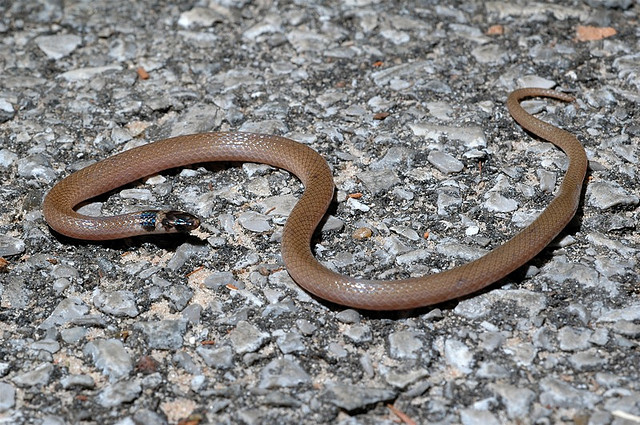

The southeastern crown snake (Tantilla coronata) is a common species of small colubrid snake endemic to the southeastern United States.
From Wikipedia: Southeastern crown snake, text under CC BY-SA 4.0.
Is the southeastern crown snake poisonous or venomous?
Mildly venomous but not dangerous: the southeastern crown snake has enlarged rear teeth and a mild venom for its prey, and a bite causes at most local swelling, which is why many sources simply call it harmless. It is not a pit viper or coral snake, the only U.S. land snakes with medically dangerous venom. Clean any bite like a small wound.
Which states have the southeastern crown snake?
Records are spread over 10 states; the top three, North Carolina, Alabama and South Carolina, hold 72% of them.
| # | State | Records | Share of state snakes | Rank in state |
|---|---|---|---|---|
| 1 | North Carolina | 232 | 1.1% | 24th of 39 |
| 2 | Alabama | 110 | 1.9% | 19th of 44 |
| 3 | South Carolina | 48 | 1.3% | 26th of 40 |
| 4 | Georgia | 37 | 0.6% | 23rd of 44 |
| 5 | Mississippi | 35 | 1.9% | 16th of 38 |
| 6 | Tennessee | 28 | 1.1% | 19th of 32 |
| 7 | Florida | 24 | 0.1% | 42nd of 49 |
| 8 | Virginia | 11 | 0.1% | 29th of 30 |
| 9 | Louisiana | 10 | 0.2% | 38th of 41 |
| 10 | Kentucky | 2 | 0.2% | 24th of 24 |
When is the southeastern crown snake seen?
Across the U.S., observation records of the southeastern crown snake run mostly March through August, peaking in April with 51% of them. Almost none are from December to February.
Where the southeastern crown snake is recorded in each state
North Carolina
North Carolina holds 232 licensed records, the 24th most recorded of 39 snakes listed there. Most of its licensed records in North Carolina come from New Hanover County, Hoke County and Bladen County. Next come Sampson County (20) and Moore County (11).
Alabama
Alabama holds 110 licensed records, the joint 19th most recorded of 44 snakes listed there. Most of its licensed records in Alabama come from Lee County, Baldwin County and Macon County. Next come Calhoun County (7) and Jackson County (6).
South Carolina
South Carolina holds 48 licensed records, the 26th most recorded of 40 snakes listed there. Most of its licensed records in South Carolina come from Charleston County, Berkeley County and Richland County. Next come Georgetown County (2) and Jasper County (2).
Georgia
Georgia holds 37 licensed records, the 23rd most recorded of 44 snakes listed there. Most of its licensed records in Georgia come from Clarke County, Cobb County and Morgan County. Next come Muscogee County (2) and Chattahoochee County (2).
Mississippi
Mississippi holds 35 licensed records, the 16th most recorded of 38 snakes listed there. Most of its licensed records in Mississippi come from Hancock County, Harrison County and Jackson County. Next come Stone County (2) and Tishomingo County (2).
Top counties in the U.S.
| # | County | State | Records | Share of U.S. |
|---|---|---|---|---|
| 1 | New Hanover County | North Carolina | 62 | 11.5% |
| 2 | Hoke County | North Carolina | 33 | 6.1% |
| 3 | Bladen County | North Carolina | 25 | 4.6% |
| 4 | Lee County | Alabama | 20 | 3.7% |
| 5 | Sampson County | North Carolina | 20 | 3.7% |
| 6 | Charleston County | South Carolina | 16 | 3.0% |
| 7 | Hancock County | Mississippi | 15 | 2.8% |
| 8 | Moore County | North Carolina | 11 | 2.0% |
| 9 | Richmond County | North Carolina | 11 | 2.0% |
| 10 | Brunswick County | North Carolina | 9 | 1.7% |
| 11 | Berkeley County | South Carolina | 9 | 1.7% |
| 12 | Baldwin County | Alabama | 8 | 1.5% |
| 13 | Scotland County | North Carolina | 8 | 1.5% |
| 14 | Macon County | Alabama | 7 | 1.3% |
| 15 | Calhoun County | Alabama | 7 | 1.3% |
How recent are the southeastern crown snake records?
The southeastern crown snake record leans on older material: only 10% of dated U.S. records come from 2017–2026, and the median record is from 1973. The oldest dated record is from 1860; the busiest year was 1981, with 44 records.
| Decade | Records | Share |
|---|---|---|
| 1860s | 1 | 0.2% |
| 1890s | 14 | 2.6% |
| 1900s | 2 | 0.4% |
| 1910s | 9 | 1.6% |
| 1920s | 5 | 0.9% |
| 1930s | 22 | 4.0% |
| 1940s | 20 | 3.6% |
| 1950s | 64 | 11.7% |
| 1960s | 99 | 18.0% |
| 1970s | 100 | 18.2% |
| 1980s | 122 | 22.2% |
| 1990s | 15 | 2.7% |
| 2000s | 17 | 3.1% |
| 2010s | 10 | 1.8% |
| 2020s | 49 | 8.9% |
Species recorded in the same counties
Of the 75 counties where the southeastern crown snake is most recorded, 44 are also top counties for the eastern rat snake, more than for any other snake. Venomous species among its neighbors: the northern cottonmouth and the eastern copperhead.
| Species | Shared counties |
|---|---|
| Eastern rat snake | 44 |
| Ring-necked snake | 38 |
| Rough greensnake | 35 |
| Corn snake | 33 |
| DeKay's brown snake | 32 |
| Northern cottonmouth venomous | 32 |
| Eastern copperhead venomous | 31 |
| Eastern hog-nosed snake | 31 |
Related species in the U.S.
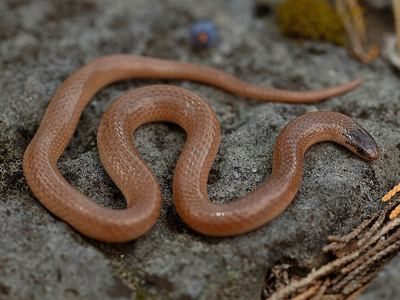
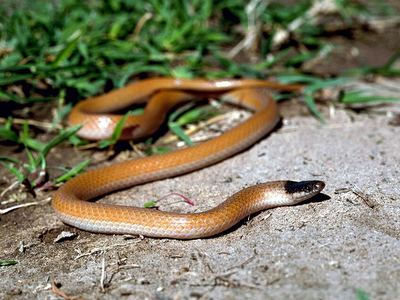
Other species of the genus Tantilla with profiles here: Flathead snake, Plains black-headed snake and Southwestern blackhead snake.
GBIF records read 2026-09-29. Listed: any license. Counted: CC0/CC BY only. How we count.