Plains black-headed snake (Tantilla nigriceps)
The plains black-headed snake is a snake in the family Colubridae with a mild venom for its prey, not dangerous to people. GBIF holds 823 licensed U.S. records of it; it reaches our listing threshold in 7 states, most of all Texas (430), Kansas (166) and New Mexico (93). Its observation records peak in August.
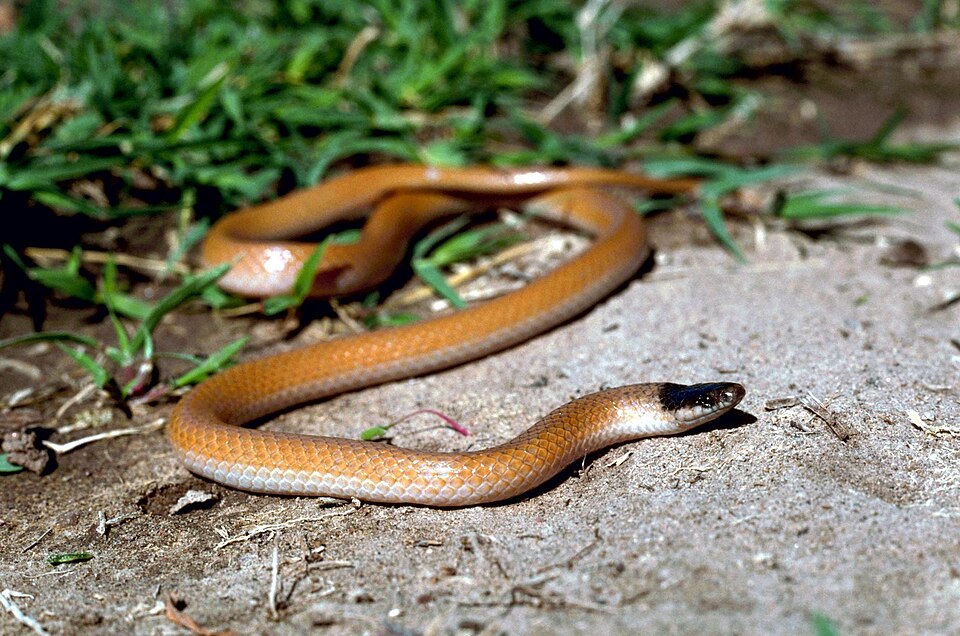

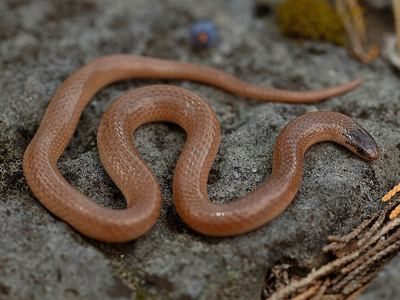
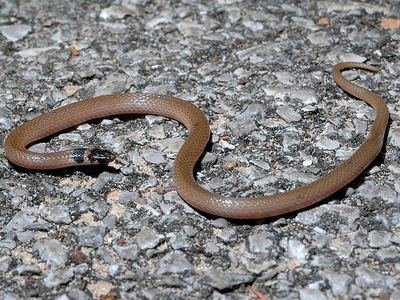
The Plains black-headed snake or Plains blackhead snake (Tantilla nigriceps) is a species of snake of the family Colubridae. They are approximately 18–38 cm (7.1–15.0 in) in length, with a uniform tan to brownish-gray. Their ventral scales are white with a pink or orange mid-line.
From Wikipedia: Plains black-headed snake, text under CC BY-SA 4.0.
Is the plains black-headed snake poisonous or venomous?
Mildly venomous but not dangerous: the plains black-headed snake has enlarged rear teeth and a mild venom for its prey, and a bite causes at most local swelling, which is why many sources simply call it harmless. It is not a pit viper or coral snake, the only U.S. land snakes with medically dangerous venom. Clean any bite like a small wound.
Which states have the plains black-headed snake?
The plains black-headed snake's U.S. record is concentrated: Texas alone holds 52% of licensed records. It is listed in 7 states in all; the next are Kansas (166), New Mexico (93) and Oklahoma (79).
| # | State | Records | Share of state snakes | Rank in state |
|---|---|---|---|---|
| 1 | Texas | 430 | 1.0% | 28th of 86 |
| 2 | Kansas | 166 | 1.1% | 28th of 44 |
| 3 | New Mexico | 93 | 1.4% | 13th of 56 |
| 4 | Oklahoma | 79 | 0.6% | 34th of 50 |
| 5 | Arizona | 34 | 0.2% | 48th of 60 |
| 6 | Colorado | 12 | 0.3% | 18th of 26 |
| 7 | Nebraska | 8 | 0.3% | 29th of 31 |
When is the plains black-headed snake seen?
Across the U.S., observation records of the plains black-headed snake run mostly April through September, peaking in August with 28% of them. Almost none are from December to February.
Where the plains black-headed snake is recorded in each state
Texas
Texas holds 430 licensed records, the 28th most recorded of 86 snakes listed there. Most of its licensed records in Texas come from Wichita County, El Paso County and Archer County. Next come Tom Green County (22) and Hudspeth County (18).
Kansas
Kansas holds 166 licensed records, the 28th most recorded of 44 snakes listed there. Most of its licensed records in Kansas come from Russell County, Ellis County and Meade County. Next come Logan County (10) and Cowley County (9).
New Mexico
New Mexico holds 93 licensed records, the 13th most recorded of 56 snakes listed there. Most of its licensed records in New Mexico come from Hidalgo County, Doña Ana County and Bernalillo County. Next come Eddy County (6) and Lea County (5).
Oklahoma
Oklahoma holds 79 licensed records, the 34th most recorded of 50 snakes listed there. Most of its licensed records in Oklahoma come from Beckham County, Greer County and Ellis County. Next come Jackson County (11) and Comanche County (7).
Arizona
Arizona holds 34 licensed records, the joint 48th most recorded of 60 snakes listed there. Most of its licensed records in Arizona come from Cochise County, Maricopa County and Pima County. Next come Graham County (2) and Pinal County (1).
Top counties in the U.S.
| # | County | State | Records | Share of U.S. |
|---|---|---|---|---|
| 1 | Russell County | Kansas | 37 | 4.5% |
| 2 | Hidalgo County | New Mexico | 29 | 3.5% |
| 3 | Wichita County | Texas | 29 | 3.5% |
| 4 | Cochise County | Arizona | 26 | 3.2% |
| 5 | Ellis County | Kansas | 26 | 3.2% |
| 6 | El Paso County | Texas | 25 | 3.0% |
| 7 | Doña Ana County | New Mexico | 24 | 2.9% |
| 8 | Archer County | Texas | 23 | 2.8% |
| 9 | Tom Green County | Texas | 22 | 2.7% |
| 10 | Hudspeth County | Texas | 18 | 2.2% |
| 11 | Reagan County | Texas | 18 | 2.2% |
| 12 | Beckham County | Oklahoma | 14 | 1.7% |
| 13 | Clay County | Texas | 14 | 1.7% |
| 14 | Denton County | Texas | 14 | 1.7% |
| 15 | Meade County | Kansas | 13 | 1.6% |
How recent are the plains black-headed snake records?
The plains black-headed snake record leans on older material: only 7% of dated U.S. records come from 2016–2025, and the median record is from 1969. The oldest dated record is from 1909; the busiest year was 1968, with 41 records.
| Decade | Records | Share |
|---|---|---|
| 1900s | 1 | 0.1% |
| 1910s | 2 | 0.3% |
| 1920s | 6 | 0.8% |
| 1930s | 20 | 2.6% |
| 1940s | 37 | 4.8% |
| 1950s | 117 | 15.1% |
| 1960s | 210 | 27.1% |
| 1970s | 108 | 13.9% |
| 1980s | 59 | 7.6% |
| 1990s | 54 | 7.0% |
| 2000s | 64 | 8.2% |
| 2010s | 59 | 7.6% |
| 2020s | 39 | 5.0% |
Species recorded in the same counties
Of the 65 counties where the plains black-headed snake is most recorded, 52 are also top counties for the gopher snake, more than for any other snake. Venomous species among its neighbors: the western massasauga.
| Species | Shared counties |
|---|---|
| Gopher snake | 52 |
| Coachwhip | 37 |
| Long-nosed snake | 37 |
| Glossy snake | 34 |
| Western ground snake | 34 |
| Chihuahuan night snake | 32 |
| Plains hog-nosed snake | 30 |
| Western massasauga venomous | 30 |
Related species in the U.S.
Other species of the genus Tantilla with profiles here: Flathead snake, Southeastern crown snake and Southwestern blackhead snake.
GBIF records read 2026-09-29. Listed: any license. Counted: CC0/CC BY only. How we count.