Northern cottonmouth (Agkistrodon piscivorus)
The northern cottonmouth is a venomous pit viper in the family Viperidae. GBIF holds 4,396 licensed U.S. records of it; it reaches our listing threshold in 16 states, most of all Texas (1,025), North Carolina (530) and Louisiana (434). Its observation records peak in October.
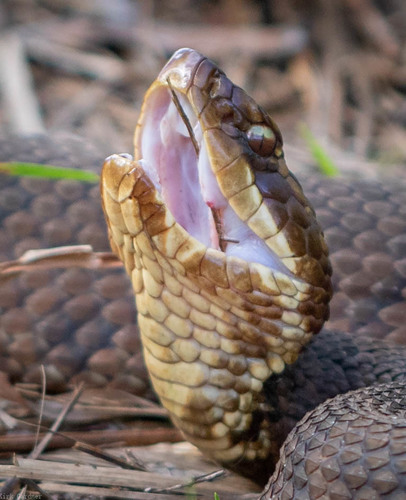
Agkistrodon piscivorus is a species of venomous snake, a pit viper in the subfamily Crotalinae of the family Viperidae. It is one of the world's few semiaquatic vipers (along with the Florida cottonmouth), and is native to the Southeastern United States. As an adult, it is large and capable of delivering a painful and potentially fatal bite.
From Wikipedia: Agkistrodon piscivorus, text under CC BY-SA 4.0.
Is the northern cottonmouth poisonous or venomous?
Yes. The northern cottonmouth is a pit viper (family Viperidae), like every rattlesnake, copperhead and cottonmouth in the U.S. Its bite needs emergency care: call 911 and keep the bitten limb still. Antivenom is given in hospital.
Snakes often mistaken for it
Species commonly confused with cottonmouths and recorded in the same states: northern water snake (recorded in all 16 of its states), plain-bellied watersnake (recorded in all 16 of its states), mud snake (recorded in 14 of its 16 states), southern watersnake (recorded in 12 of its 16 states) and diamondback water snake (recorded in 11 of its 16 states).
Which states have the northern cottonmouth?
Records are spread over 16 states; the top three, Texas, North Carolina and Louisiana, hold 45% of them.
| # | State | Records | Share of state snakes | Rank in state |
|---|---|---|---|---|
| 1 | Texas | 1,025 | 2.5% | 13th of 86 |
| 2 | North Carolina | 530 | 2.6% | 14th of 39 |
| 3 | Louisiana | 434 | 8.6% | 4th of 41 |
| 4 | Oklahoma | 429 | 3.2% | 11th of 50 |
| 5 | Virginia | 349 | 3.2% | 11th of 30 |
| 6 | Florida | 279 | 1.3% | 16th of 49 |
| 7 | Illinois | 259 | 9.3% | 3rd of 33 |
| 8 | Alabama | 201 | 3.5% | 9th of 44 |
| 9 | Arkansas | 190 | 3.6% | 4th of 36 |
| 10 | South Carolina | 183 | 5.0% | 4th of 40 |
| 11 | Mississippi | 160 | 8.6% | 2nd of 38 |
| 12 | Tennessee | 138 | 5.3% | 6th of 32 |
| 13 | Georgia | 97 | 1.6% | 14th of 44 |
| 14 | Missouri | 70 | 3.7% | 7th of 36 |
| 15 | Kentucky | 39 | 3.1% | 14th of 24 |
| 16 | Kansas | 8 | 0.1% | 43rd of 44 |
When is the northern cottonmouth seen?
Across the U.S., observation records of the northern cottonmouth run mostly March through November, peaking in October with 18% of them. Winter (December to February) holds 6% of them.
Season by state
Observation records run through most of the year in Louisiana, Mississippi and Tennessee. Among states whose main season falls within one calendar year, it starts earliest in March (Alabama, Arkansas, Georgia, Illinois, South Carolina, Texas and Virginia) and latest in April (Missouri and North Carolina). The most common peak month is April, shared by Alabama, Arkansas, Louisiana and South Carolina.
| State | Main season | Peak month | Observation records |
|---|---|---|---|
| Texas | March through November | May | 524 |
| Illinois | March through October | October | 236 |
| Louisiana | most of the year | April | 208 |
| Tennessee | most of the year | March | 125 |
| North Carolina | April through November | June | 105 |
| Arkansas | March through October | April | 95 |
| Alabama | March through October | April | 90 |
| Mississippi | most of the year | May | 87 |
| Missouri | April through October | October | 61 |
| South Carolina | March through October | April | 60 |
| Georgia | March through November | May | 45 |
| Virginia | March through November | July | 44 |
Where the northern cottonmouth is recorded in each state
Texas
Texas holds 1,025 licensed records, the 13th most recorded of 86 snakes listed there. Its observation records in Texas run mostly March through November, peaking in May; most licensed records come from Harris County, Denton County and Hardin County. Next come Gonzales County (40) and Brazoria County (36).
North Carolina
North Carolina holds 530 licensed records, the 14th most recorded of 39 snakes listed there. Its observation records in North Carolina run mostly April through November, peaking in June; most licensed records come from Dare County, Currituck County and Moore County. Next come Brunswick County (24) and Columbus County (24).
Louisiana
Louisiana holds 434 licensed records, the 4th most recorded of 41 snakes listed there. Its observation records in Louisiana run through most of the year, peaking in April; most licensed records come from East Baton Rouge Parish, Saint Tammany Parish and Saint John the Baptist Parish. Next come Orleans Parish (22) and Natchitoches Parish (21).
Oklahoma
Oklahoma holds 429 licensed records, the 11th most recorded of 50 snakes listed there. Most of its licensed records in Oklahoma come from McCurtain County, Rogers County and LeFlore County. Next come Atoka County (41) and Pushmataha County (20).
Virginia
Virginia holds 349 licensed records, the 11th most recorded of 30 snakes listed there. Its observation records in Virginia run mostly March through November, peaking in July; most licensed records come from Chesterfield County, Colonial Heights and Virginia Beach. Next come Chesapeake (25) and Hopewell (25).
Florida
Florida holds 279 licensed records, the 16th most recorded of 49 snakes listed there. Most of its licensed records in Florida come from Miami-Dade County, Liberty County and Collier County. Next come Palm Beach County (18) and Franklin County (16).
Illinois
Illinois holds 259 licensed records, the 3rd most recorded of 33 snakes listed there. Its observation records in Illinois run mostly March through October, peaking in October; most licensed records come from Union County, Johnson County and Jackson County. Next come Massac County (2) and Monroe County (2).
Alabama
Alabama holds 201 licensed records, the 9th most recorded of 44 snakes listed there. Its observation records in Alabama run mostly March through October, peaking in April; most licensed records come from Baldwin County, Lee County and Mobile County. Next come Elmore County (13) and Macon County (12).
Arkansas
Arkansas holds 190 licensed records, the 4th most recorded of 36 snakes listed there. Its observation records in Arkansas run mostly March through October, peaking in April; most licensed records come from Pike County, Columbia County and Monroe County. Next come Polk County (11) and Ashley County (10).
South Carolina
South Carolina holds 183 licensed records, the 4th most recorded of 40 snakes listed there. Its observation records in South Carolina run mostly March through October, peaking in April; most licensed records come from Charleston County, Berkeley County and Richland County. Next come Aiken County (11) and Darlington County (9).
Mississippi
Mississippi holds 160 licensed records, the 2nd most recorded of 38 snakes listed there. Its observation records in Mississippi run through most of the year, peaking in May; most licensed records come from Jackson County, Lafayette County and Harrison County. Next come Hancock County (8) and Oktibbeha County (6).
Tennessee
Tennessee holds 138 licensed records, the 6th most recorded of 32 snakes listed there. Its observation records in Tennessee run through most of the year, peaking in March; most licensed records come from Cheatham County, Humphreys County and Dickson County. Next come Shelby County (8) and Benton County (7).
Georgia
Georgia holds 97 licensed records, the 14th most recorded of 44 snakes listed there. Its observation records in Georgia run mostly March through November, peaking in May; most licensed records come from Charlton County, Columbia County and Jones County. Next come Richmond County (7) and Bibb County (3).
Missouri
Missouri holds 70 licensed records, the 7th most recorded of 36 snakes listed there. Its observation records in Missouri run mostly April through October, peaking in October; most licensed records come from Cape Girardeau County, Perry County and Miller County. Next come Shannon County (4) and Stoddard County (2).
Kentucky
Kentucky holds 39 licensed records, the 14th most recorded of 24 snakes listed there. Most of its licensed records in Kentucky come from Hickman County, Lyon County and Marshall County. Next come Union County (2) and Graves County (2).
Top counties in the U.S.
| # | County | State | Records | Share of U.S. |
|---|---|---|---|---|
| 1 | Union County | Illinois | 212 | 4.8% |
| 2 | McCurtain County | Oklahoma | 148 | 3.4% |
| 3 | Harris County | Texas | 143 | 3.3% |
| 4 | Chesterfield County | Virginia | 126 | 2.9% |
| 5 | Colonial Heights | Virginia | 93 | 2.1% |
| 6 | Cheatham County | Tennessee | 76 | 1.7% |
| 7 | Dare County | North Carolina | 73 | 1.7% |
| 8 | East Baton Rouge Parish | Louisiana | 66 | 1.5% |
| 9 | Virginia Beach | Virginia | 65 | 1.5% |
| 10 | Rogers County | Oklahoma | 57 | 1.3% |
| 11 | LeFlore County | Oklahoma | 52 | 1.2% |
| 12 | Denton County | Texas | 49 | 1.1% |
| 13 | Charleston County | South Carolina | 46 | 1.0% |
| 14 | Currituck County | North Carolina | 45 | 1.0% |
| 15 | Hardin County | Texas | 43 | 1.0% |
How recent are the northern cottonmouth records?
Records of the northern cottonmouth span old collections and new observations: 40% date from 2017–2026, and the median record is from 2004. The oldest dated record is from 1881; the busiest year was 2024, with 356 records.
| Decade | Records | Share |
|---|---|---|
| 1880s | 8 | 0.2% |
| 1890s | 14 | 0.3% |
| 1900s | 14 | 0.3% |
| 1910s | 46 | 1.1% |
| 1920s | 63 | 1.5% |
| 1930s | 180 | 4.2% |
| 1940s | 236 | 5.5% |
| 1950s | 249 | 5.8% |
| 1960s | 424 | 9.9% |
| 1970s | 475 | 11.1% |
| 1980s | 261 | 6.1% |
| 1990s | 89 | 2.1% |
| 2000s | 248 | 5.8% |
| 2010s | 525 | 12.3% |
| 2020s | 1,438 | 33.7% |
Species recorded in the same counties
Of the 205 counties where the northern cottonmouth is most recorded, 96 are also top counties for the eastern racer, more than for any other snake.
| Species | Shared counties |
|---|---|
| Eastern racer | 96 |
| Plain-bellied watersnake | 95 |
| Rough greensnake | 85 |
| Southern watersnake | 81 |
| DeKay's brown snake | 79 |
| Eastern copperhead venomous | 76 |
| Eastern rat snake | 71 |
| Ring-necked snake | 71 |
Related species in the U.S.
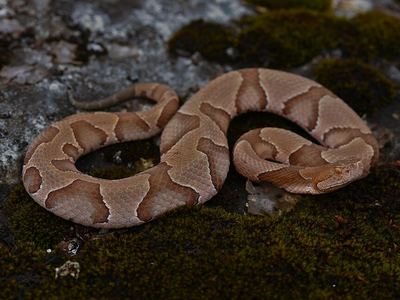
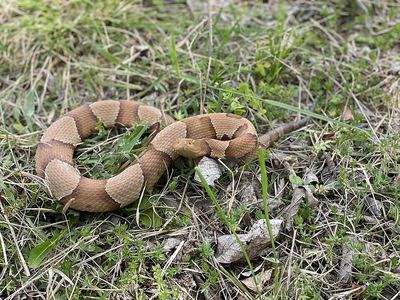
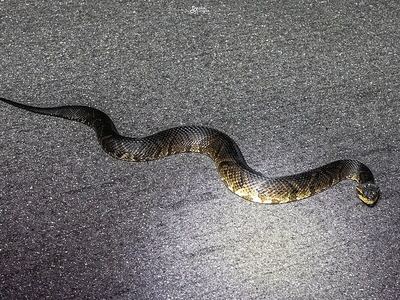
Other species of the genus Agkistrodon with profiles here: Eastern copperhead, Broad-banded copperhead and Florida cottonmouth.
GBIF records read 2026-09-29. Listed: any license. Counted: CC0/CC BY only. How we count.