Texas brown tarantula (Aphonopelma hentzi)
The Texas brown tarantula is a spider in the family Theraphosidae that is not dangerous to people. GBIF holds 592 licensed U.S. records of it; it reaches our listing threshold in 8 states, most of all Texas (323), Oklahoma (75) and Colorado (71). Its observation records peak in September.
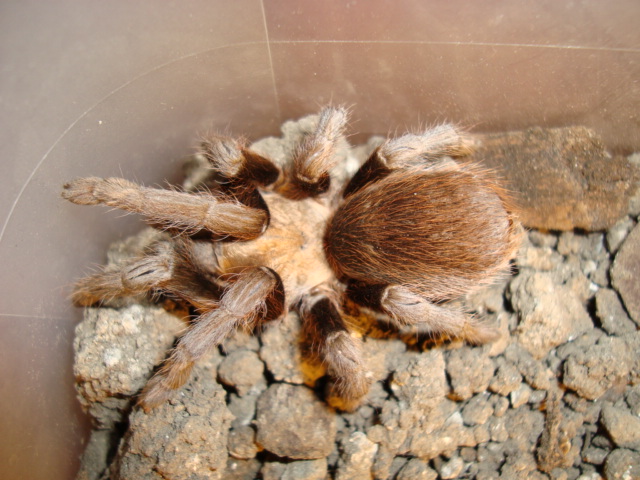
The Texas brown tarantula, Aphonopelma hentzi, also known as the Oklahoma brown tarantula or Missouri tarantula, is one of the most common species of tarantula living in the Southern United States today. Texas brown tarantulas can grow to leg spans in excess of 10 cm (4 in), and weigh more than 85 g (3 oz) as adults. Their bodies are dark brown, though shades may vary between individual tarantulas.
From Wikipedia: Texas brown tarantula, text under CC BY-SA 4.0.
Is the Texas brown tarantula poisonous or venomous?
Not in any medically significant way. Like almost all spiders the Texas brown tarantula (family Theraphosidae) has venom for its prey, but it is not a widow or recluse, the two U.S. groups whose bites need medical attention.
Which states have the Texas brown tarantula?
The Texas brown tarantula's U.S. record is concentrated: Texas alone holds 55% of licensed records. It is listed in 8 states in all; the next are Oklahoma (75), Colorado (71) and New Mexico (55).
| # | State | Records | Share of state spiders | Rank in state |
|---|---|---|---|---|
| 1 | Texas | 323 | 1.1% | 17th of 386 |
| 2 | Oklahoma | 75 | 1.5% | 11th of 149 |
| 3 | Colorado | 71 | 1.7% | 9th of 378 |
| 4 | New Mexico | 55 | 2.3% | 2nd of 247 |
| 5 | Missouri | 29 | 1.2% | 18th of 117 |
| 6 | Arkansas | 13 | 0.8% | 32nd of 114 |
| 7 | Kansas | 8 | 0.5% | 38th of 94 |
| 8 | Louisiana | 5 | 0.1% | 83rd of 107 |
When is the Texas brown tarantula seen?
Across the U.S., observation records of the Texas brown tarantula run mostly April through October, peaking in September with 22% of them. Almost none are from December to February.
Season by state
Among states whose main season falls within one calendar year, it starts earliest in April (Oklahoma and Texas) and latest in June (Colorado and New Mexico). Each of these states peaks in a different month: May in Texas, June in Oklahoma, September in Colorado and October in New Mexico.
| State | Main season | Peak month | Observation records |
|---|---|---|---|
| Texas | April through November | May | 321 |
| Oklahoma | April through October | June | 72 |
| Colorado | June through October | September | 71 |
| New Mexico | June through October | October | 55 |
Where the Texas brown tarantula is recorded in each state
Texas
Texas holds 323 licensed records, the 17th most recorded of 386 spiders listed there. Its observation records in Texas run mostly April through November, peaking in May; most licensed records come from Brewster County, Dallas County and Travis County. Next come Jeff Davis County (19) and Williamson County (16).
Oklahoma
Oklahoma holds 75 licensed records, the joint 11th most recorded of 149 spiders listed there. Its observation records in Oklahoma run mostly April through October, peaking in June; most licensed records come from Osage County, Comanche County and Pawnee County. Next come Cimarron County (3) and Murray County (3).
Colorado
Colorado holds 71 licensed records, the 9th most recorded of 378 spiders listed there. Its observation records in Colorado run mostly June through October, peaking in September; most licensed records come from Otero County, Pueblo County and Bent County. Next come Las Animas County (7) and Crowley County (1).
New Mexico
New Mexico holds 55 licensed records, the 2nd most recorded of 247 spiders listed there. Its observation records in New Mexico run mostly June through October, peaking in October; most licensed records come from Doña Ana County, Eddy County and Hidalgo County. Next come Bernalillo County (4) and Otero County (4).
Top counties in the U.S.
| # | County | State | Records | Share of U.S. |
|---|---|---|---|---|
| 1 | Brewster County | Texas | 59 | 10.0% |
| 2 | Dallas County | Texas | 59 | 10.0% |
| 3 | Otero County | Colorado | 42 | 7.1% |
| 4 | Osage County | Oklahoma | 31 | 5.2% |
| 5 | Travis County | Texas | 29 | 4.9% |
| 6 | Jeff Davis County | Texas | 19 | 3.2% |
| 7 | Doña Ana County | New Mexico | 16 | 2.7% |
| 8 | Williamson County | Texas | 16 | 2.7% |
| 9 | Bexar County | Texas | 13 | 2.2% |
| 10 | Tarrant County | Texas | 13 | 2.2% |
| 11 | Pueblo County | Colorado | 11 | 1.9% |
| 12 | Eddy County | New Mexico | 11 | 1.9% |
| 13 | Edwards County | Texas | 10 | 1.7% |
| 14 | Bent County | Colorado | 9 | 1.5% |
| 15 | Hays County | Texas | 8 | 1.4% |
How recent are the Texas brown tarantula records?
Most of what is known about the Texas brown tarantula is recent: 83% of dated U.S. records were made in 2017–2026, and half date from 2022 or later. The oldest dated record is from 1928; the busiest year was 2025, with 77 records.
| Decade | Records | Share |
|---|---|---|
| 1920s | 1 | 0.2% |
| 1930s | 4 | 0.7% |
| 1940s | 1 | 0.2% |
| 1960s | 1 | 0.2% |
| 1980s | 1 | 0.2% |
| 1990s | 9 | 1.5% |
| 2000s | 17 | 2.9% |
| 2010s | 162 | 27.3% |
| 2020s | 397 | 66.9% |
Species recorded in the same counties
Of the 51 counties where the Texas brown tarantula is most recorded, 20 are also top counties for the bold jumper, more than for any other spider. Venomous species among its neighbors: the western black widow and the brown recluse.
| Species | Shared counties |
|---|---|
| Bold jumper | 20 |
| Western black widow venomous | 17 |
| Apache jumping spider | 16 |
| Banded garden spider | 16 |
| Western spotted orbweaver | 16 |
| Cardinal jumper | 14 |
| Black-and-yellow argiope | 13 |
| Brown recluse venomous | 12 |
Related species in the U.S.
Other species of the genus Aphonopelma with profiles here: Bay Area blonde and Desert blond tarantula.

GBIF records read 2026-09-29. Listed: any license. Counted: CC0/CC BY only. How we count.