Nearctic white-striped running crab spider (Philodromus rufus)
The Nearctic white-striped running crab spider is a spider in the family Philodromidae that is not dangerous to people. GBIF holds 366 licensed U.S. records of it; it reaches our listing threshold in 29 states, most of all Washington (91), Alaska (71) and Ohio (33). Its observation records peak in April.
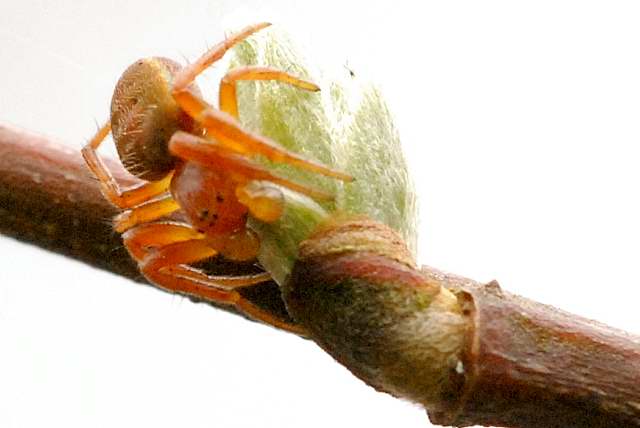

Philodromus rufus, also known as the white-striped running crab spider, is a species of running crab spider in the family Philodromidae. It is found in North America, Europe, Turkey, Caucasus, Russia (Siberia), Central Asia, China, Korea, and Japan.
From Wikipedia: Philodromus rufus, text under CC BY-SA 4.0.
Is the Nearctic white-striped running crab spider poisonous or venomous?
Not in any medically significant way. Like almost all spiders the Nearctic white-striped running crab spider (family Philodromidae) has venom for its prey, but it is not a widow or recluse, the two U.S. groups whose bites need medical attention.
Which states have the Nearctic white-striped running crab spider?
Records are spread over 29 states; the top three, Washington, Alaska and Ohio, hold 53% of them.
| # | State | Records | Share of state spiders | Rank in state |
|---|---|---|---|---|
| 1 | Washington | 91 | 2.3% | 8th of 157 |
| 2 | Alaska | 71 | 0.3% | 66th of 280 |
| 3 | Ohio | 33 | 0.5% | 50th of 332 |
| 4 | Virginia | 22 | 0.2% | 79th of 176 |
| 5 | Oregon | 14 | 0.5% | 34th of 88 |
| 6 | California | 13 | 0.0% | 202nd of 309 |
| 7 | Massachusetts | 11 | 0.2% | 72nd of 189 |
| 8 | Missouri | 11 | 0.5% | 44th of 117 |
| 9 | Illinois | 10 | 0.1% | 191st of 243 |
| 10 | Nebraska | 9 | 0.7% | 31st of 71 |
| 11 | New York | 8 | 0.1% | 84th of 149 |
| 12 | Pennsylvania | 7 | 0.1% | 103rd of 164 |
| 13 | Maryland | 6 | 0.1% | 107th of 153 |
| 14 | New Jersey | 6 | 0.3% | 69th of 127 |
| 15 | Wisconsin | 5 | 0.2% | 102nd of 149 |
| 16 | Oklahoma | 4 | 0.1% | 110th of 149 |
| 17 | Tennessee | 4 | 0.1% | 94th of 138 |
| 18 | Colorado | 3 | 0.1% | 98th of 378 |
| 19 | Kentucky | 3 | 0.2% | 77th of 103 |
| 20 | Georgia | 2 | 0.0% | 152nd of 186 |
| 21 | Michigan | 2 | 0.1% | 85th of 122 |
| 22 | Minnesota | 2 | 0.1% | 108th of 145 |
| 23 | North Carolina | 2 | 0.0% | 154th of 184 |
| 24 | New Mexico | 1 | 0.0% | 143rd of 247 |
| 25 | Vermont | 1 | 0.1% | 66th of 74 |
| 26 | Alabama | 0 | — | — |
| 27 | Maine | 0 | — | — |
| 28 | Rhode Island | 0 | — | — |
| 29 | West Virginia | 0 | — | — |
When is the Nearctic white-striped running crab spider seen?
Across the U.S., observation records of the Nearctic white-striped running crab spider run through most of the year, peaking in April with 19% of them. Winter (December to February) holds 11% of them.
Season by state
Observation records run through most of the year in Washington. Each of these states peaks in a different month: April in Washington and May in Ohio.
| State | Main season | Peak month | Observation records |
|---|---|---|---|
| Washington | most of the year | April | 89 |
| Ohio | February through October | May | 33 |
Where the Nearctic white-striped running crab spider is recorded in each state
Washington
Washington holds 91 licensed records, the 8th most recorded of 157 spiders listed there. Its observation records in Washington run through most of the year, peaking in April; most licensed records come from King County, Clallam County and Pierce County. Next come Thurston County (7) and Skagit County (5).
Alaska
Alaska holds 71 licensed records, the 66th most recorded of 280 spiders listed there. Most of its licensed records in Alaska come from Kenai Peninsula Borough, Fairbanks North Star Borough and Yukon-Koyukuk Census Area. Next come Matanuska-Susitna Borough (7) and Anchorage Municipality (7).
Ohio
Ohio holds 33 licensed records, the 50th most recorded of 332 spiders listed there. Its observation records in Ohio run mostly February through October, peaking in May; most licensed records come from Portage County, Franklin County and Richland County. Next come Medina County (2) and Montgomery County (2).
Top counties in the U.S.
| # | County | State | Records | Share of U.S. |
|---|---|---|---|---|
| 1 | King County | Washington | 34 | 9.3% |
| 2 | Kenai Peninsula Borough | Alaska | 17 | 4.6% |
| 3 | Fairbanks North Star Borough | Alaska | 14 | 3.8% |
| 4 | Clallam County | Washington | 14 | 3.8% |
| 5 | Yukon-Koyukuk Census Area | Alaska | 11 | 3.0% |
| 6 | Pierce County | Washington | 11 | 3.0% |
| 7 | Portage County | Ohio | 9 | 2.5% |
| 8 | Matanuska-Susitna Borough | Alaska | 7 | 1.9% |
| 9 | Anchorage Municipality | Alaska | 7 | 1.9% |
| 10 | Thurston County | Washington | 7 | 1.9% |
| 11 | Franklin County | Ohio | 6 | 1.6% |
| 12 | Skagit County | Washington | 5 | 1.4% |
| 13 | Prince of Wales-Outer Ketchikan Census Area | Alaska | 4 | 1.1% |
| 14 | Skagway-Yakutat-Angoon Census Area | Alaska | 4 | 1.1% |
| 15 | Richland County | Ohio | 4 | 1.1% |
How recent are the Nearctic white-striped running crab spider records?
Records of the Nearctic white-striped running crab spider span old collections and new observations: 70% date from 2017–2026, and the median record is from 2023. The oldest dated record is from 1940; the busiest year was 2025, with 68 records.
| Decade | Records | Share |
|---|---|---|
| 1940s | 1 | 0.3% |
| 1960s | 6 | 1.6% |
| 1970s | 5 | 1.3% |
| 1980s | 8 | 2.1% |
| 1990s | 17 | 4.5% |
| 2000s | 24 | 6.4% |
| 2010s | 73 | 19.4% |
| 2020s | 243 | 64.5% |
Species recorded in the same counties
Of the 41 counties where the Nearctic white-striped running crab spider is most recorded, 27 are also top counties for the sixspotted orbweaver, more than for any other spider. None of its closest neighbors is venomous.
| Species | Shared counties |
|---|---|
| Sixspotted orbweaver | 27 |
| Bronze jumper | 25 |
| Goldenrod crab spider | 22 |
| Zebra spider | 20 |
| Versicolor long-jawed orbweaver | 19 |
| Garden spider | 18 |
| Bold jumper | 14 |
| Boreal combfoot | 14 |
GBIF records read 2026-09-29. Listed: any license. Counted: CC0/CC BY only. How we count.