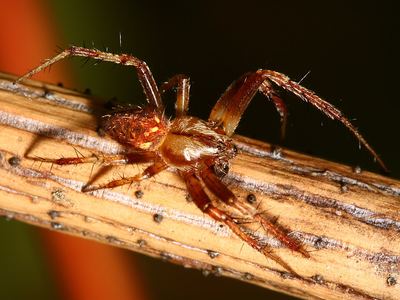
Joro spider (Trichonephila clavata)
The Joro spider is a spider in the family Araneidae that is not dangerous to people. GBIF holds 830 licensed U.S. records of it; it reaches our listing threshold in 6 states, most of all Georgia (565), South Carolina (173) and North Carolina (50). Its observation records peak in October.
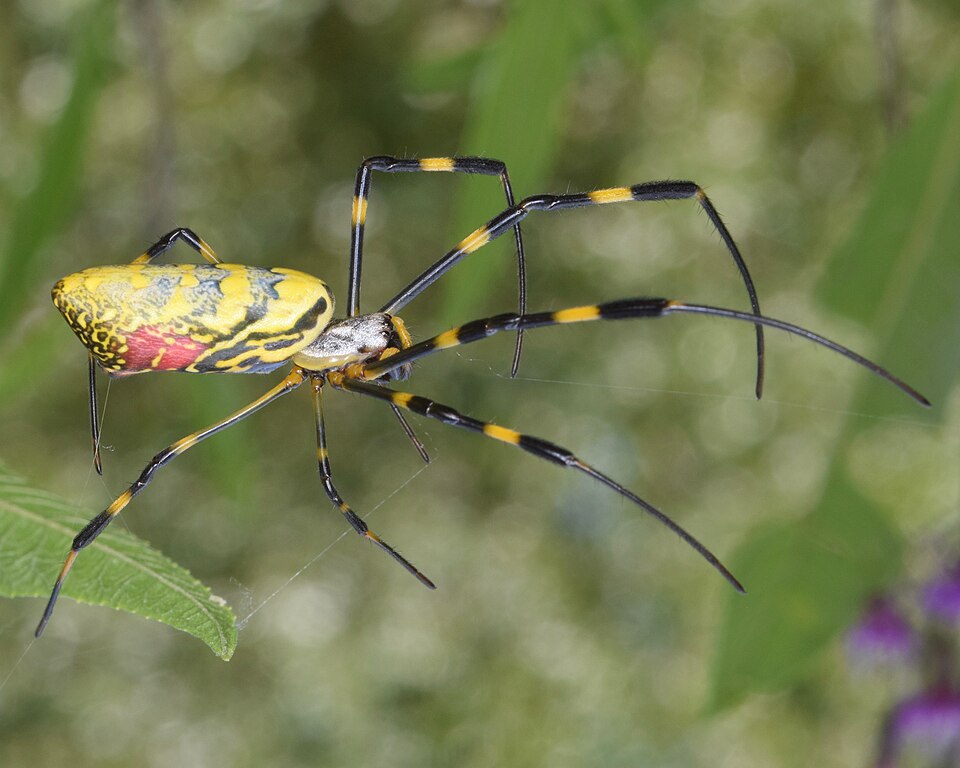
.jpg)
Trichonephila clavata, also known as the Joro-spider (ジョロウグモ, Jorō-gumo), is a spider in the Trichonephila genus. Native to East Asia, it is found throughout China, Japan (except Hokkaidō), Korea, and Taiwan, and has been spreading across North America since the 2010s. It rarely bites humans, and its venom is not medically significant.
From Wikipedia: Trichonephila clavata, text under CC BY-SA 4.0.
Is the Joro spider poisonous or venomous?
Not in any medically significant way. Like almost all spiders the Joro spider (family Araneidae) has venom for its prey, but it is not a widow or recluse, the two U.S. groups whose bites need medical attention.
Which states have the Joro spider?
The Joro spider's U.S. record is concentrated: Georgia alone holds 68% of licensed records. It is listed in 6 states in all; the next are South Carolina (173), North Carolina (50) and Tennessee (29).
| # | State | Records | Share of state spiders | Rank in state |
|---|---|---|---|---|
| 1 | Georgia | 565 | 8.4% | 1st of 186 |
| 2 | South Carolina | 173 | 7.3% | 2nd of 121 |
| 3 | North Carolina | 50 | 0.6% | 39th of 184 |
| 4 | Tennessee | 29 | 0.8% | 37th of 138 |
| 5 | Maryland | 9 | 0.2% | 88th of 153 |
| 6 | Alabama | 3 | 0.1% | 101st of 143 |
When is the Joro spider seen?
Across the U.S., observation records of the Joro spider run mostly July through November, peaking in October with 26% of them. Almost none are from December to February.
Season by state
Among states whose main season falls within one calendar year, it starts earliest in July (Georgia and North Carolina) and latest in August (South Carolina). Each of these states peaks in a different month: July in North Carolina, September in Georgia and October in South Carolina.
| State | Main season | Peak month | Observation records |
|---|---|---|---|
| Georgia | July through November | September | 563 |
| South Carolina | August through November | October | 173 |
| North Carolina | July through October | July | 50 |
Where the Joro spider is recorded in each state
Georgia
Georgia holds 565 licensed records, the most recorded of 186 spiders listed there. Its observation records in Georgia run mostly July through November, peaking in September; most licensed records come from DeKalb County, Clarke County and Cobb County. Next come Fulton County (37) and Newton County (36).
South Carolina
South Carolina holds 173 licensed records, the 2nd most recorded of 121 spiders listed there. Its observation records in South Carolina run mostly August through November, peaking in October; most licensed records come from Greenville County, Spartanburg County and Pickens County. Next come Abbeville County (9) and Anderson County (8).
North Carolina
North Carolina holds 50 licensed records, the joint 39th most recorded of 184 spiders listed there. Its observation records in North Carolina run mostly July through October, peaking in July; most licensed records come from Polk County, Cherokee County and Transylvania County. Next come Buncombe County (3) and Macon County (3).
Top counties in the U.S.
| # | County | State | Records | Share of U.S. |
|---|---|---|---|---|
| 1 | DeKalb County | Georgia | 136 | 16.4% |
| 2 | Greenville County | South Carolina | 93 | 11.2% |
| 3 | Clarke County | Georgia | 71 | 8.6% |
| 4 | Cobb County | Georgia | 53 | 6.4% |
| 5 | Spartanburg County | South Carolina | 39 | 4.7% |
| 6 | Fulton County | Georgia | 37 | 4.5% |
| 7 | Newton County | Georgia | 36 | 4.3% |
| 8 | Gwinnett County | Georgia | 28 | 3.4% |
| 9 | Polk County | North Carolina | 26 | 3.1% |
| 10 | Forsyth County | Georgia | 20 | 2.4% |
| 11 | Cherokee County | Georgia | 16 | 1.9% |
| 12 | Barrow County | Georgia | 16 | 1.9% |
| 13 | Oconee County | Georgia | 15 | 1.8% |
| 14 | Bartow County | Georgia | 15 | 1.8% |
| 15 | Pickens County | South Carolina | 14 | 1.7% |
How recent are the Joro spider records?
Most of what is known about the Joro spider is recent: 100% of dated U.S. records were made in 2017–2026, and half date from 2024 or later. The oldest dated record is from 2019; the busiest year was 2025, with 262 records.
| Decade | Records | Share |
|---|---|---|
| 2010s | 4 | 0.5% |
| 2020s | 868 | 99.5% |
Species recorded in the same counties
Of the 36 counties where the Joro spider is most recorded, 23 are also top counties for the marbled orbweaver, more than for any other spider. None of its closest neighbors is venomous.
| Species | Shared counties |
|---|---|
| Marbled orbweaver | 23 |
| Arrowhead orbweaver | 22 |
| Orchard orbweaver | 21 |
| Magnolia green jumper | 20 |
| Nursery web spider | 18 |
| Familiar jumping spider | 17 |
| Spined micrathena | 17 |
| Spotted orbweaver | 17 |
Related species in the U.S.
Other species of the genus Trichonephila with profiles here: American golden orb weaver.
GBIF records read 2026-09-29. Listed: any license. Counted: CC0/CC BY only. How we count.