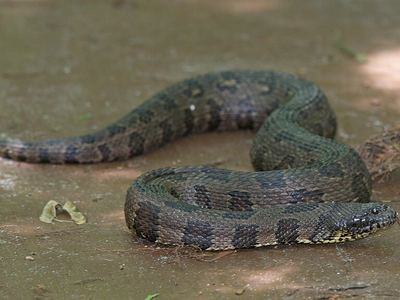
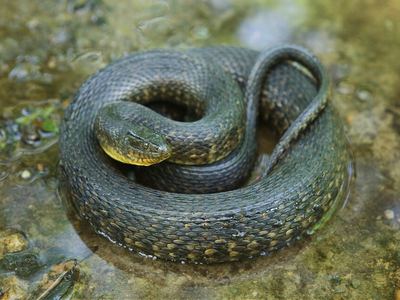
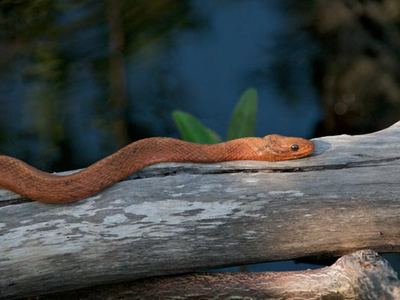
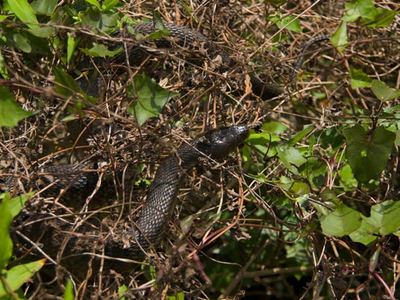
Southern watersnake (Nerodia fasciata)
The southern watersnake is a non-venomous snake in the family Colubridae. GBIF holds 5,219 licensed U.S. records of it; it reaches our listing threshold in 14 states, most of all Florida (1,488), North Carolina (1,158) and Texas (814). Outside its native range it is introduced in California. Its observation records peak in April.
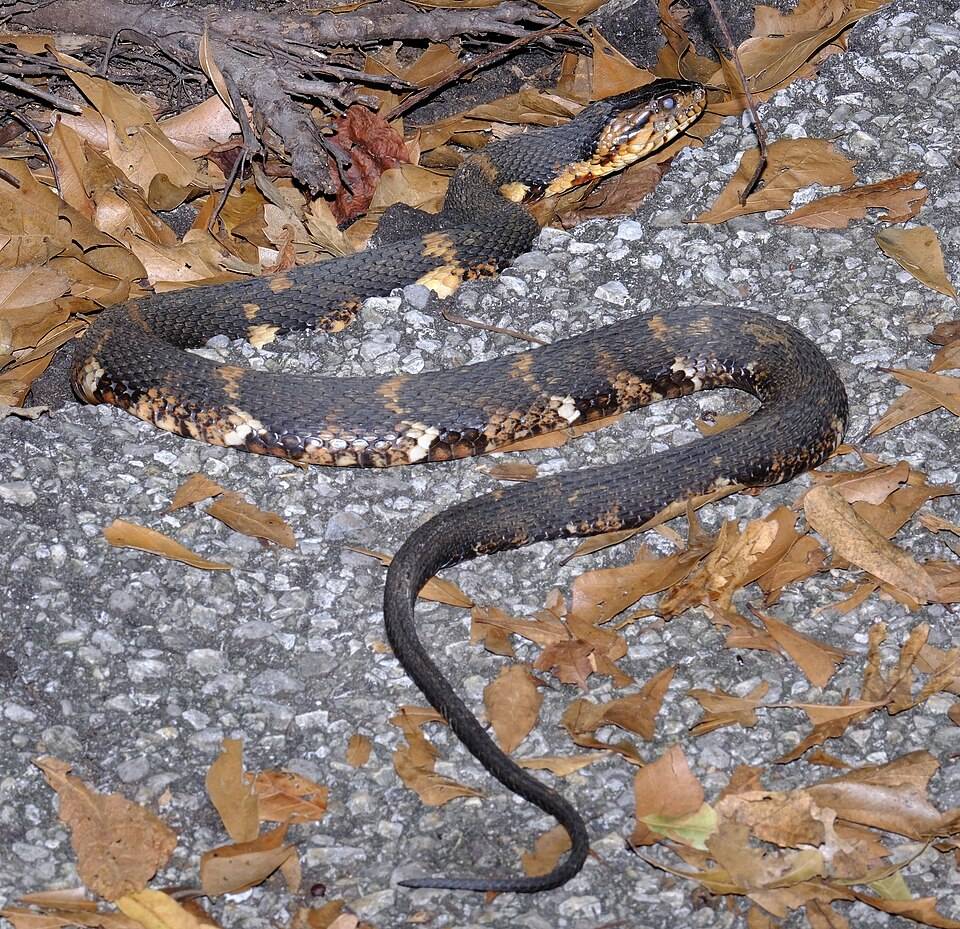

The banded water snake or southern water snake (Nerodia fasciata) is a species of mostly aquatic, nonvenomous, colubrid snakes most commonly found in the Midwest, Southeastern United States.
From Wikipedia: Banded water snake, text under CC BY-SA 4.0.
Is the southern watersnake poisonous or venomous?
No. The southern watersnake is non-venomous: it belongs to the family Colubridae, not to the pit vipers or coral snakes, the only U.S. land snakes with medically dangerous venom. It may bite if handled; clean the bite like any small wound.
Often mistaken for
The southern watersnake is non-venomous, but people often take it for cottonmouths (both are recorded in 12 of its 14 states).
Which states have the southern watersnake?
Records are spread over 14 states; the top three, Florida, North Carolina and Texas, hold 66% of them. It is the most recorded snake of all in Louisiana.
| # | State | Records | Share of state snakes | Rank in state |
|---|---|---|---|---|
| 1 | Florida | 1,488 | 7.1% | 3rd of 49 |
| 2 | North Carolina | 1,158 | 5.6% | 7th of 39 |
| 3 | Texas | 814 | 2.0% | 17th of 86 |
| 4 | Louisiana | 673 | 13.4% | 1st of 41 |
| 5 | Alabama | 252 | 4.4% | 3rd of 44 |
| 6 | South Carolina | 225 | 6.2% | 2nd of 40 |
| 7 | Georgia | 155 | 2.5% | 9th of 44 |
| 8 | Arkansas | 130 | 2.5% | 6th of 36 |
| 9 | Arizona | 119 | 0.6% | 36th of 60 |
| 10 | Mississippi | 72 | 3.9% | 9th of 38 |
| 11 | Oklahoma | 68 | 0.5% | 38th of 50 |
| 12 | California | 30 | 0.0% | 42nd of 46 |
| 13 | Missouri | 12 | 0.6% | 27th of 36 |
| 14 | Tennessee | 11 | 0.4% | 24th of 32 |
When is the southern watersnake seen?
Across the U.S., observation records of the southern watersnake run through most of the year, peaking in April with 20% of them. Winter (December to February) holds 16% of them.
Season by state
Observation records run through most of the year in Florida. Among states whose main season falls within one calendar year, it starts earliest in February (Louisiana and Texas) and latest in March (Arkansas, Georgia, North Carolina and South Carolina). The most common peak month is April, shared by Georgia, Louisiana, North Carolina, South Carolina and Texas.
| State | Main season | Peak month | Observation records |
|---|---|---|---|
| Florida | most of the year | March | 721 |
| Texas | February through October | April | 432 |
| Louisiana | February through October | April | 315 |
| Arkansas | March through October | May | 69 |
| South Carolina | March through September | April | 51 |
| Georgia | March through September | April | 40 |
| North Carolina | March through September | April | 40 |
Where the southern watersnake is recorded in each state
Florida
Florida holds 1,488 licensed records, the 3rd most recorded of 49 snakes listed there. Its observation records in Florida run through most of the year, peaking in March; most licensed records come from Miami-Dade County, Alachua County and Orange County. Next come Collier County (113) and Lee County (104).
North Carolina
North Carolina holds 1,158 licensed records, the 7th most recorded of 39 snakes listed there. Its observation records in North Carolina run mostly March through September, peaking in April; most licensed records come from Columbus County, Sampson County and Scotland County. Next come Brunswick County (72) and Bladen County (57).
Texas
Texas holds 814 licensed records, the 17th most recorded of 86 snakes listed there. Its observation records in Texas run mostly February through October, peaking in April; most licensed records come from Harris County, Brazos County and Chambers County. Next come Brazoria County (36) and Jefferson County (32).
Louisiana
Louisiana holds 673 licensed records, the most recorded of 41 snakes listed there. Its observation records in Louisiana run mostly February through October, peaking in April; most licensed records come from East Baton Rouge Parish, Jefferson Parish and Saint Tammany Parish. Next come Plaquemines Parish (34) and Saint James Parish (25).
Alabama
Alabama holds 252 licensed records, the 3rd most recorded of 44 snakes listed there. Most of its licensed records in Alabama come from Baldwin County, Geneva County and Mobile County. Next come Covington County (39) and Houston County (30).
South Carolina
South Carolina holds 225 licensed records, the 2nd most recorded of 40 snakes listed there. Its observation records in South Carolina run mostly March through September, peaking in April; most licensed records come from Berkeley County, Charleston County and Jasper County. Next come Georgetown County (17) and Richland County (17).
Georgia
Georgia holds 155 licensed records, the 9th most recorded of 44 snakes listed there. Its observation records in Georgia run mostly March through September, peaking in April; most licensed records come from Charlton County, Chatham County and Ware County. Next come Bulloch County (7) and Jenkins County (6).
Arkansas
Arkansas holds 130 licensed records, the joint 6th most recorded of 36 snakes listed there. Its observation records in Arkansas run mostly March through October, peaking in May; most licensed records come from Lonoke County, Columbia County and Pulaski County. Next come Mississippi County (6) and Poinsett County (6).
Arizona
Arizona holds 119 licensed records, the joint 36th most recorded of 60 snakes listed there. Most of its licensed records in Arizona come from Yuma County.
Mississippi
Mississippi holds 72 licensed records, the 9th most recorded of 38 snakes listed there. Most of its licensed records in Mississippi come from Harrison County, Jackson County and Hancock County. Next come Lawrence County (4) and Adams County (3).
Oklahoma
Oklahoma holds 68 licensed records, the joint 38th most recorded of 50 snakes listed there. Most of its licensed records in Oklahoma come from McCurtain County, Atoka County and Choctaw County. Next come Marshall County (2) and Pushmataha County (2).
California
California holds 30 licensed records, the 42nd most recorded of 46 snakes listed there. Most of its licensed records in California come from Los Angeles County, Sacramento County and Yolo County.
Top counties in the U.S.
| # | County | State | Records | Share of U.S. |
|---|---|---|---|---|
| 1 | Columbus County | North Carolina | 506 | 9.7% |
| 2 | Harris County | Texas | 312 | 6.0% |
| 3 | Miami-Dade County | Florida | 176 | 3.4% |
| 4 | Alachua County | Florida | 153 | 2.9% |
| 5 | Orange County | Florida | 144 | 2.8% |
| 6 | East Baton Rouge Parish | Louisiana | 140 | 2.7% |
| 7 | Yuma County | Arizona | 119 | 2.3% |
| 8 | Collier County | Florida | 113 | 2.2% |
| 9 | Lee County | Florida | 104 | 2.0% |
| 10 | Jefferson Parish | Louisiana | 81 | 1.6% |
| 11 | Sampson County | North Carolina | 78 | 1.5% |
| 12 | Scotland County | North Carolina | 76 | 1.5% |
| 13 | Brunswick County | North Carolina | 72 | 1.4% |
| 14 | Liberty County | Florida | 71 | 1.4% |
| 15 | Monroe County | Florida | 64 | 1.2% |
How recent are the southern watersnake records?
The southern watersnake record leans on older material: only 35% of dated U.S. records come from 2017–2026, and the median record is from 1993. The oldest dated record is from 1862; the busiest year was 2024, with 245 records.
| Decade | Records | Share |
|---|---|---|
| 1860s | 1 | 0.0% |
| 1870s | 4 | 0.1% |
| 1880s | 6 | 0.1% |
| 1890s | 3 | 0.1% |
| 1900s | 16 | 0.3% |
| 1910s | 46 | 0.9% |
| 1920s | 112 | 2.3% |
| 1930s | 211 | 4.3% |
| 1940s | 204 | 4.2% |
| 1950s | 250 | 5.1% |
| 1960s | 883 | 18.1% |
| 1970s | 418 | 8.5% |
| 1980s | 244 | 5.0% |
| 1990s | 232 | 4.7% |
| 2000s | 265 | 5.4% |
| 2010s | 636 | 13.0% |
| 2020s | 1,358 | 27.8% |
Species recorded in the same counties
Of the 143 counties where the southern watersnake is most recorded, 81 are also top counties for the northern cottonmouth, more than for any other snake. Venomous species among its neighbors: the northern cottonmouth.
| Species | Shared counties |
|---|---|
| Northern cottonmouth venomous | 81 |
| Eastern racer | 77 |
| Rough greensnake | 65 |
| Mud snake | 63 |
| Eastern hog-nosed snake | 61 |
| DeKay's brown snake | 59 |
| Plain-bellied watersnake | 57 |
| Corn snake | 53 |
Related species in the U.S.
Other species of the genus Nerodia with profiles here: Northern water snake, Diamondback water snake, Plain-bellied watersnake, Brown water snake, Green water snake, Salt marsh snake and Florida green water snake.
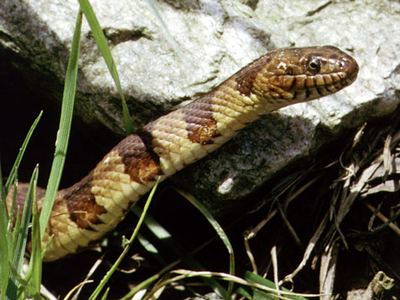
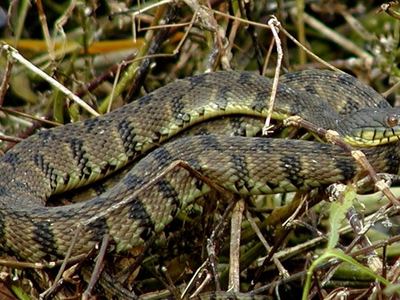
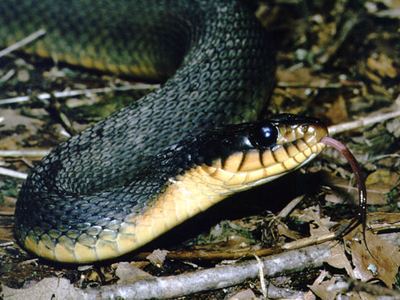
GBIF records read 2026-09-29. Listed: any license. Counted: CC0/CC BY only. How we count.