Southern house spider (Kukulcania hibernalis)
The southern house spider is a spider in the family Filistatidae that is not dangerous to people. GBIF holds 313 licensed U.S. records of it; it reaches our listing threshold in 12 states, most of all Texas (67), Florida (65) and North Carolina (56). Its observation records peak in July.
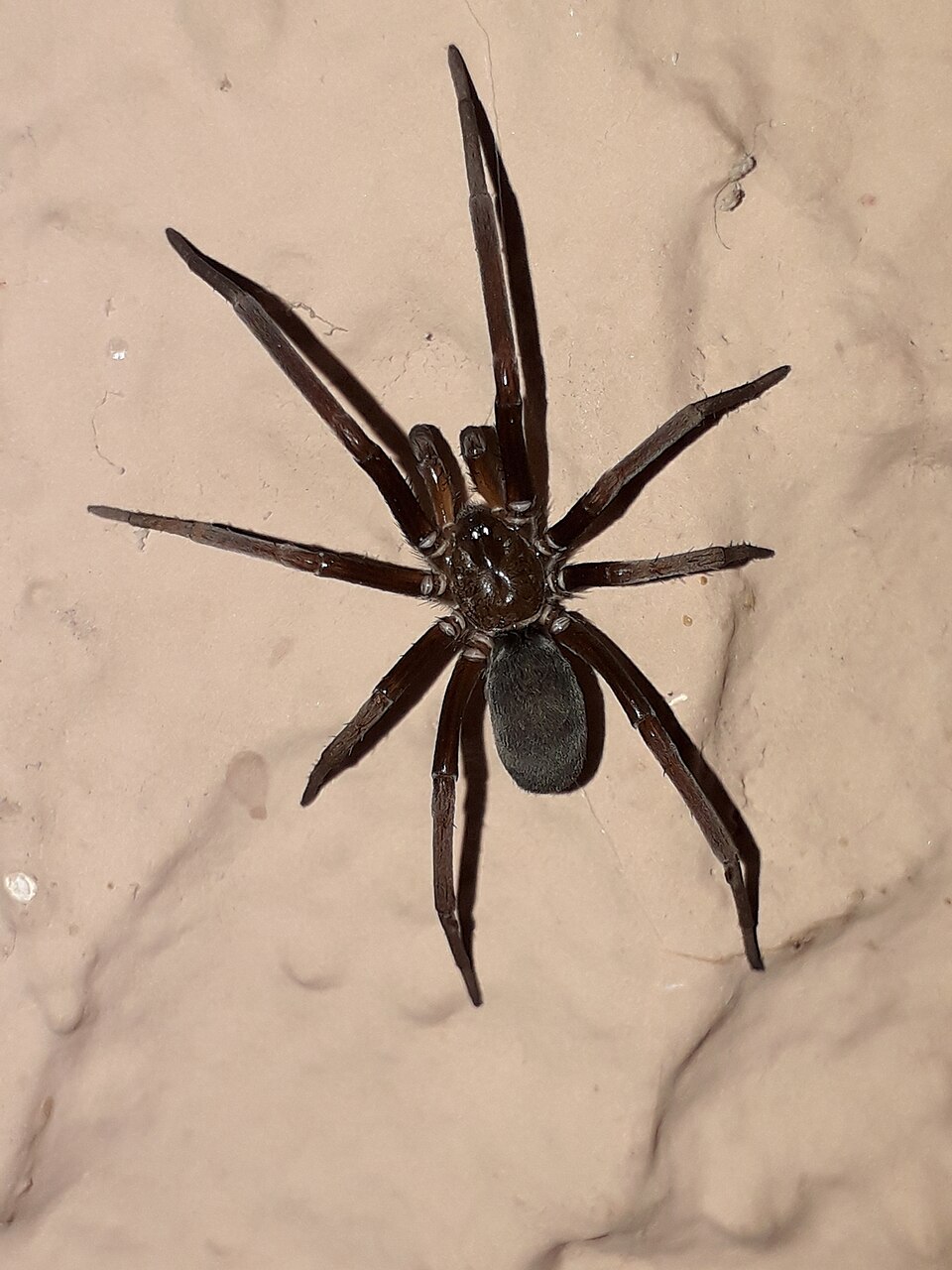

The southern house spider is a species of large spider in the family Filistatidae. Currently given the scientific name Kukulcania hibernalis, it was formerly known as Filistata hibernalis. Found in the Americas, it exhibits strong sexual dimorphism.
From Wikipedia: Southern house spider, text under CC BY-SA 4.0.
Is the southern house spider poisonous or venomous?
Not in any medically significant way. Like almost all spiders the southern house spider (family Filistatidae) has venom for its prey, but it is not a widow or recluse, the two U.S. groups whose bites need medical attention.
Often mistaken for
The southern house spider is not dangerous to people, but people often take it for recluse spiders (both are recorded in 7 of its 12 states).
Which states have the southern house spider?
Records are spread over 12 states; the top three, Texas, Florida and North Carolina, hold 60% of them.
| # | State | Records | Share of state spiders | Rank in state |
|---|---|---|---|---|
| 1 | Texas | 67 | 0.2% | 80th of 386 |
| 2 | Florida | 65 | 0.5% | 28th of 237 |
| 3 | North Carolina | 56 | 0.7% | 35th of 184 |
| 4 | Georgia | 48 | 0.7% | 31st of 186 |
| 5 | South Carolina | 23 | 1.0% | 24th of 121 |
| 6 | Louisiana | 17 | 0.4% | 46th of 107 |
| 7 | Alabama | 16 | 0.4% | 57th of 143 |
| 8 | Mississippi | 7 | 0.5% | 40th of 117 |
| 9 | Virginia | 6 | 0.1% | 127th of 176 |
| 10 | Arkansas | 2 | 0.1% | 86th of 114 |
| 11 | Tennessee | 2 | 0.1% | 112th of 138 |
| 12 | New Mexico | 0 | — | — |
When is the southern house spider seen?
Across the U.S., observation records of the southern house spider run through most of the year, peaking in July with 15% of them. Winter (December to February) holds 16% of them.
Season by state
Observation records run through most of the year in Florida, Georgia and North Carolina. The most common peak month is August, shared by Georgia and Texas.
| State | Main season | Peak month | Observation records |
|---|---|---|---|
| North Carolina | most of the year | June | 56 |
| Texas | March through October | August | 51 |
| Florida | most of the year | January | 49 |
| Georgia | most of the year | August | 48 |
Where the southern house spider is recorded in each state
Texas
Texas holds 67 licensed records, the 80th most recorded of 386 spiders listed there. Its observation records in Texas run mostly March through October, peaking in August; most licensed records come from Harris County, Hidalgo County and Brazoria County. Next come Jasper County (5) and Hardin County (4).
Florida
Florida holds 65 licensed records, the 28th most recorded of 237 spiders listed there. Its observation records in Florida run through most of the year, peaking in January; most licensed records come from Alachua County, Hardee County and Miami-Dade County. Next come Sarasota County (7) and Franklin County (6).
North Carolina
North Carolina holds 56 licensed records, the joint 35th most recorded of 184 spiders listed there. Its observation records in North Carolina run through most of the year, peaking in June; most licensed records come from Orange County, New Hanover County and Mecklenburg County. Next come Cumberland County (4) and Durham County (4).
Georgia
Georgia holds 48 licensed records, the 31st most recorded of 186 spiders listed there. Its observation records in Georgia run through most of the year, peaking in August; most licensed records come from Clarke County, Bryan County and Floyd County. Next come DeKalb County (4) and Fulton County (4).
Top counties in the U.S.
| # | County | State | Records | Share of U.S. |
|---|---|---|---|---|
| 1 | Orange County | North Carolina | 21 | 6.7% |
| 2 | Harris County | Texas | 13 | 4.2% |
| 3 | Hidalgo County | Texas | 12 | 3.8% |
| 4 | Alachua County | Florida | 9 | 2.9% |
| 5 | Clarke County | Georgia | 9 | 2.9% |
| 6 | Hardee County | Florida | 7 | 2.2% |
| 7 | Miami-Dade County | Florida | 7 | 2.2% |
| 8 | Sarasota County | Florida | 7 | 2.2% |
| 9 | New Hanover County | North Carolina | 7 | 2.2% |
| 10 | Brazoria County | Texas | 7 | 2.2% |
| 11 | Franklin County | Florida | 6 | 1.9% |
| 12 | Bryan County | Georgia | 5 | 1.6% |
| 13 | Floyd County | Georgia | 5 | 1.6% |
| 14 | Mecklenburg County | North Carolina | 5 | 1.6% |
| 15 | Jasper County | Texas | 5 | 1.6% |
How recent are the southern house spider records?
Most of what is known about the southern house spider is recent: 87% of dated U.S. records were made in 2017–2026, and half date from 2022 or later. The oldest dated record is from 1927; the busiest year was 2025, with 60 records.
| Decade | Records | Share |
|---|---|---|
| 1920s | 4 | 1.2% |
| 1930s | 7 | 2.1% |
| 1940s | 8 | 2.4% |
| 1960s | 2 | 0.6% |
| 1980s | 1 | 0.3% |
| 2000s | 4 | 1.2% |
| 2010s | 55 | 16.7% |
| 2020s | 248 | 75.4% |
Species recorded in the same counties
Of the 60 counties where the southern house spider is most recorded, 33 are also top counties for the sylvan jumping spider, more than for any other spider. None of its closest neighbors is venomous.
| Species | Shared counties |
|---|---|
| Sylvan jumping spider | 33 |
| Spiny-backed orbweaver | 30 |
| Twin-flagged jumping spider | 30 |
| Arabesque orbweaver | 28 |
| Magnolia green jumper | 28 |
| White-banded fishing spider | 28 |
| American golden orb weaver | 26 |
| Black-and-yellow argiope | 26 |
GBIF records read 2026-09-29. Listed: any license. Counted: CC0/CC BY only. How we count.