Texas coral snake (Micrurus tener)
The Texas coral snake is a venomous elapid snake in the family Elapidae. GBIF holds 613 licensed U.S. records of it; it reaches our listing threshold in 2 states, most of all Texas (571) and Louisiana (38). Its observation records peak in April.
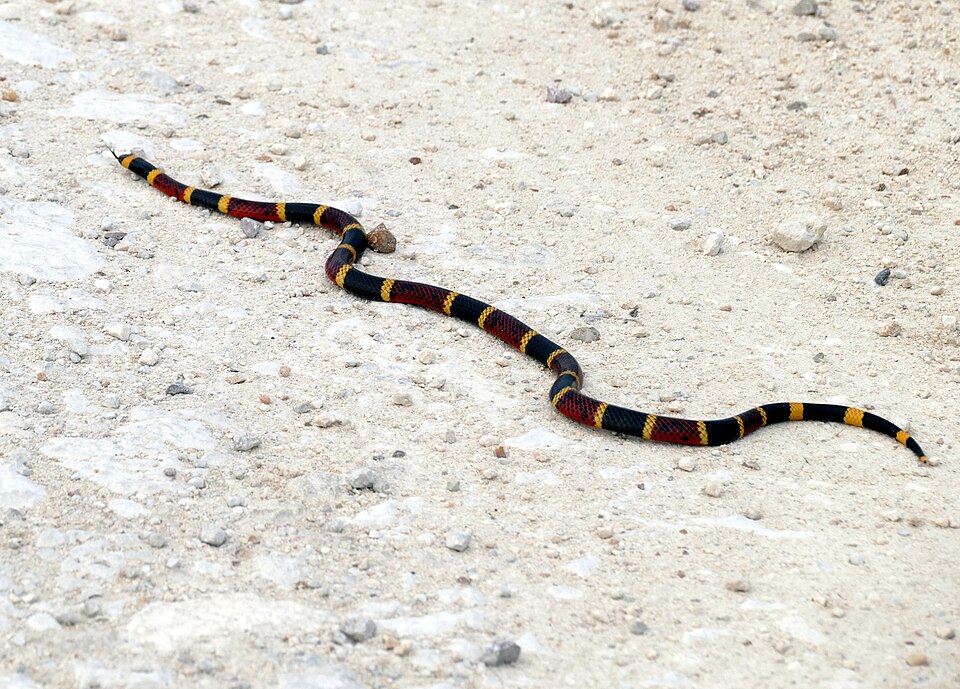
Micrurus tener, commonly known as the Texas coral snake and el coralillo tejano in Mexican Spanish, is a species of venomous snake in the family Elapidae. The species is native to the southern and southwestern United States and adjacent northeastern and central Mexico. Six subspecies are recognized as being valid, including the nominotypical subspecies, Micrurus tener tener.
From Wikipedia: Texas coral snake, text under CC BY-SA 4.0.
Is the Texas coral snake poisonous or venomous?
Yes. The Texas coral snake is an elapid (family Elapidae), the family of coral snakes. Its venom acts on nerves, and symptoms can be delayed for hours, so any bite needs a hospital even if it seems minor.
Snakes often mistaken for it
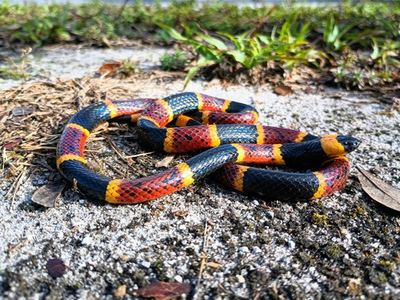
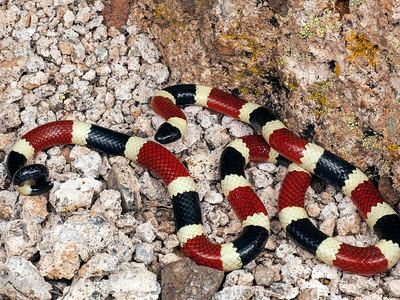
Species commonly confused with coral snakes and recorded in the same states: central plains milksnake (recorded in all 2 of its states), eastern milksnake (recorded in all 2 of its states), scarlet snake (recorded in all 2 of its states), long-nosed snake (recorded in 1 of its 2 states) and Mexican milksnake (recorded in 1 of its 2 states).
Which states have the Texas coral snake?
The Texas coral snake's U.S. record is concentrated: Texas alone holds 93% of licensed records. It is listed in 2 states in all; the next are Louisiana (38).
The count includes 42 records filed under the older name Micrurus fulvius in Texas.
| # | State | Records | Share of state snakes | Rank in state |
|---|---|---|---|---|
| 1 | Texas | 571 | 1.4% | 23rd of 86 |
| 2 | Louisiana | 38 | 0.8% | 23rd of 41 |
When is the Texas coral snake seen?
Across the U.S., observation records of the Texas coral snake run mostly March through November, peaking in April with 21% of them. Winter (December to February) holds 6% of them.
Where the Texas coral snake is recorded in each state
Texas
Texas holds 571 licensed records, the 23rd most recorded of 86 snakes listed there. Its observation records in Texas run mostly March through November, peaking in April; most licensed records come from Travis County, Harris County and Brazos County. Next come Bexar County (35) and Hays County (24).
Louisiana
Louisiana holds 38 licensed records, the joint 23rd most recorded of 41 snakes listed there. Most of its licensed records in Louisiana come from Jackson Parish, Natchitoches Parish and Allen Parish. Next come Vernon Parish (4) and Union Parish (3).
Top counties in the U.S.
| # | County | State | Records | Share of U.S. |
|---|---|---|---|---|
| 1 | Travis County | Texas | 61 | 10.0% |
| 2 | Harris County | Texas | 40 | 6.5% |
| 3 | Brazos County | Texas | 39 | 6.4% |
| 4 | Bexar County | Texas | 35 | 5.7% |
| 5 | Hays County | Texas | 24 | 3.9% |
| 6 | Bastrop County | Texas | 17 | 2.8% |
| 7 | Wilson County | Texas | 16 | 2.6% |
| 8 | Brazoria County | Texas | 15 | 2.4% |
| 9 | Cameron County | Texas | 15 | 2.4% |
| 10 | Kendall County | Texas | 14 | 2.3% |
| 11 | Montgomery County | Texas | 11 | 1.8% |
| 12 | Williamson County | Texas | 11 | 1.8% |
| 13 | Jim Hogg County | Texas | 9 | 1.5% |
| 14 | Medina County | Texas | 9 | 1.5% |
| 15 | Blanco County | Texas | 9 | 1.5% |
How recent are the Texas coral snake records?
The Texas coral snake record leans on older material: only 34% of dated U.S. records come from 2017–2026, and the median record is from 2007. The oldest dated record is from 1856; the busiest year was 2023, with 30 records.
| Decade | Records | Share |
|---|---|---|
| 1850s | 1 | 0.2% |
| 1870s | 1 | 0.2% |
| 1880s | 3 | 0.5% |
| 1890s | 1 | 0.2% |
| 1900s | 6 | 1.0% |
| 1910s | 5 | 0.9% |
| 1920s | 5 | 0.9% |
| 1930s | 10 | 1.7% |
| 1940s | 33 | 5.7% |
| 1950s | 48 | 8.4% |
| 1960s | 59 | 10.3% |
| 1970s | 27 | 4.7% |
| 1980s | 21 | 3.7% |
| 1990s | 20 | 3.5% |
| 2000s | 64 | 11.1% |
| 2010s | 120 | 20.9% |
| 2020s | 150 | 26.1% |
Species recorded in the same counties
Of the 46 counties where the Texas coral snake is most recorded, 19 are also top counties for the western rat snake, more than for any other snake.
| Species | Shared counties |
|---|---|
| Western rat snake | 19 |
| Eastern hog-nosed snake | 18 |
| Rough greensnake | 18 |
| DeKay's brown snake | 16 |
| Eastern copperhead venomous | 16 |
| Gopher snake | 15 |
| Rough earthsnake | 15 |
| Eastern racer | 14 |
Related species in the U.S.
Other species of the genus Micrurus with profiles here: Eastern coral snake.

GBIF records read 2026-09-29. Listed: any license. Counted: CC0/CC BY only. How we count.