Texas blind snake (Rena dulcis)
The Texas blind snake is a non-venomous snake in the family Leptotyphlopidae. GBIF holds 1,311 licensed U.S. records of it; it reaches our listing threshold in 5 states, most of all Texas (989), Oklahoma (248) and Kansas (44). Its observation records peak in April.
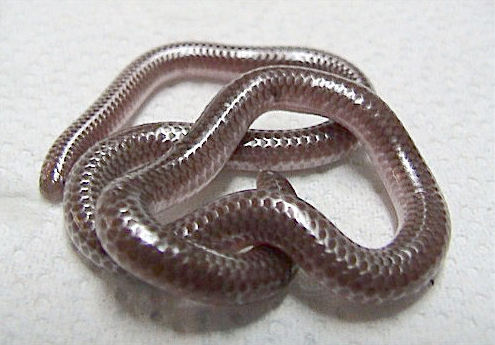
Rena dulcis, also known commonly as the Texas blind snake, the Texas slender blind snake, or the Texas threadsnake, is a species of snake in the family Leptotyphlopidae. The species is endemic to the Southwestern United States and adjacent northern Mexico. Three subspecies are currently recognized, including the nominate subspecies described here.
From Wikipedia: Rena dulcis, text under CC BY-SA 4.0.
Is the Texas blind snake poisonous or venomous?
No. The Texas blind snake is a blind snake (family Leptotyphlopidae): it has no venom, and its tiny mouth cannot bite a person. Pit vipers and coral snakes are the only U.S. land snakes with medically dangerous venom.
Which states have the Texas blind snake?
The Texas blind snake's U.S. record is concentrated: Texas alone holds 75% of licensed records. It is listed in 5 states in all; the next are Oklahoma (248), Kansas (44) and Arizona (14).
| # | State | Records | Share of state snakes | Rank in state |
|---|---|---|---|---|
| 1 | Texas | 989 | 2.4% | 14th of 86 |
| 2 | Oklahoma | 248 | 1.9% | 20th of 50 |
| 3 | Kansas | 44 | 0.3% | 36th of 44 |
| 4 | Arizona | 14 | 0.1% | 57th of 60 |
| 5 | New Mexico | 14 | 0.2% | 41st of 56 |
When is the Texas blind snake seen?
Across the U.S., observation records of the Texas blind snake run mostly March through August, peaking in April with 33% of them. Winter (December to February) holds 2% of them.
Where the Texas blind snake is recorded in each state
Texas
Texas holds 989 licensed records, the 14th most recorded of 86 snakes listed there. Its observation records in Texas run mostly March through August, peaking in April; most licensed records come from Travis County, Bexar County and Hutchinson County. Next come Tom Green County (35) and Clay County (34).
Oklahoma
Oklahoma holds 248 licensed records, the 20th most recorded of 50 snakes listed there. Most of its licensed records in Oklahoma come from Comanche County, Seminole County and Love County. Next come Beckham County (20) and Greer County (14).
Kansas
Kansas holds 44 licensed records, the 36th most recorded of 44 snakes listed there. Most of its licensed records in Kansas come from Clark County, Meade County and Barber County. Next come Sumner County (6) and Comanche County (2).
Top counties in the U.S.
| # | County | State | Records | Share of U.S. |
|---|---|---|---|---|
| 1 | Travis County | Texas | 111 | 8.5% |
| 2 | Comanche County | Oklahoma | 75 | 5.7% |
| 3 | Bexar County | Texas | 49 | 3.7% |
| 4 | Hutchinson County | Texas | 47 | 3.6% |
| 5 | Tom Green County | Texas | 35 | 2.7% |
| 6 | Clay County | Texas | 34 | 2.6% |
| 7 | Hays County | Texas | 33 | 2.5% |
| 8 | Bosque County | Texas | 29 | 2.2% |
| 9 | Denton County | Texas | 29 | 2.2% |
| 10 | Bandera County | Texas | 28 | 2.1% |
| 11 | Seminole County | Oklahoma | 25 | 1.9% |
| 12 | Williamson County | Texas | 23 | 1.8% |
| 13 | Love County | Oklahoma | 22 | 1.7% |
| 14 | Cooke County | Texas | 21 | 1.6% |
| 15 | Beckham County | Oklahoma | 20 | 1.5% |
How recent are the Texas blind snake records?
The Texas blind snake record leans on older material: only 15% of dated U.S. records come from 2017–2026, and the median record is from 1973. The oldest dated record is from 1905; the busiest year was 1950, with 64 records.
| Decade | Records | Share |
|---|---|---|
| 1900s | 23 | 1.9% |
| 1910s | 1 | 0.1% |
| 1920s | 5 | 0.4% |
| 1930s | 33 | 2.7% |
| 1940s | 82 | 6.7% |
| 1950s | 178 | 14.6% |
| 1960s | 220 | 18.1% |
| 1970s | 114 | 9.4% |
| 1980s | 59 | 4.8% |
| 1990s | 101 | 8.3% |
| 2000s | 126 | 10.4% |
| 2010s | 122 | 10.0% |
| 2020s | 153 | 12.6% |
Species recorded in the same counties
Of the 39 counties where the Texas blind snake is most recorded, 19 are also top counties for the western ground snake, more than for any other snake. None of its closest neighbors is venomous.
| Species | Shared counties |
|---|---|
| Western ground snake | 19 |
| Gopher snake | 18 |
| Plains black-headed snake | 18 |
| Flathead snake | 16 |
| Coachwhip | 15 |
| Speckled kingsnake | 15 |
| Chihuahuan night snake | 13 |
| Plain-bellied watersnake | 13 |
Related species in the U.S.
Other species of the genus Rena with profiles here: Western threadsnake.

GBIF records read 2026-09-29. Listed: any license. Counted: CC0/CC BY only. How we count.