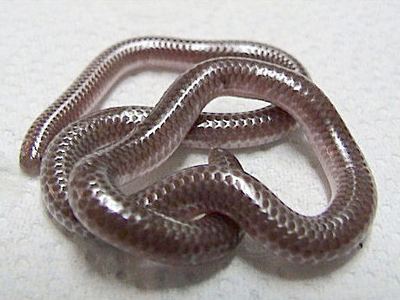
Western threadsnake (Rena humilis)
The western threadsnake is a non-venomous snake in the family Leptotyphlopidae. GBIF holds 1,143 licensed U.S. records of it; it reaches our listing threshold in 5 states, most of all California (674), Arizona (375) and Texas (47). Its observation records peak in May.
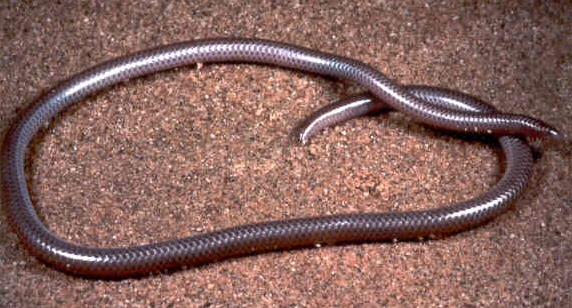
Rena humilis, known commonly as the western blind snake, the western slender blind snake, and the western threadsnake, is a species of snake in the family Leptotyphlopidae. The species is native to the southwestern United States and northern Mexico. Six subspecies are recognized as being valid, including the nominate subspecies described here.
From Wikipedia: Rena humilis, text under CC BY-SA 4.0.
Is the western threadsnake poisonous or venomous?
No. The western threadsnake is a blind snake (family Leptotyphlopidae): it has no venom, and its tiny mouth cannot bite a person. Pit vipers and coral snakes are the only U.S. land snakes with medically dangerous venom.
Which states have the western threadsnake?
The western threadsnake's U.S. record is concentrated: California alone holds 59% of licensed records. It is listed in 5 states in all; the next are Arizona (375), Texas (47) and New Mexico (22).
The count includes 47 records filed under the older name Rena segrega in Arizona (6), New Mexico (8) and Texas (33).
| # | State | Records | Share of state snakes | Rank in state |
|---|---|---|---|---|
| 1 | California | 674 | 0.9% | 20th of 46 |
| 2 | Arizona | 375 | 1.8% | 17th of 60 |
| 3 | Texas | 47 | 0.1% | 68th of 86 |
| 4 | New Mexico | 22 | 0.3% | 36th of 56 |
| 5 | Nevada | 20 | 0.5% | 22nd of 27 |
When is the western threadsnake seen?
Across the U.S., observation records of the western threadsnake run mostly May through September, peaking in May with 26% of them. Winter (December to February) holds 4% of them.
Where the western threadsnake is recorded in each state
California
California holds 674 licensed records, the 20th most recorded of 46 snakes listed there. Its observation records in California run mostly May through September, peaking in May; most licensed records come from San Diego County, Imperial County and Riverside County. Next come San Bernardino County (36) and Inyo County (31).
Arizona
Arizona holds 375 licensed records, the 17th most recorded of 60 snakes listed there. Most of its licensed records in Arizona come from Pima County, Maricopa County and Yuma County. Next come Yavapai County (22) and Pinal County (16).
Texas
Texas holds 47 licensed records, the joint 68th most recorded of 86 snakes listed there. Most of its licensed records in Texas come from El Paso County, Hudspeth County and Brewster County. Next come Terrell County (4) and Jeff Davis County (2).
Top counties in the U.S.
| # | County | State | Records | Share of U.S. |
|---|---|---|---|---|
| 1 | San Diego County | California | 289 | 25.3% |
| 2 | Imperial County | California | 193 | 16.9% |
| 3 | Pima County | Arizona | 178 | 15.6% |
| 4 | Maricopa County | Arizona | 82 | 7.2% |
| 5 | Riverside County | California | 81 | 7.1% |
| 6 | Yuma County | Arizona | 58 | 5.1% |
| 7 | San Bernardino County | California | 36 | 3.1% |
| 8 | Inyo County | California | 31 | 2.7% |
| 9 | Los Angeles County | California | 30 | 2.6% |
| 10 | Yavapai County | Arizona | 22 | 1.9% |
| 11 | El Paso County | Texas | 20 | 1.7% |
| 12 | Pinal County | Arizona | 16 | 1.4% |
| 13 | Cochise County | Arizona | 9 | 0.8% |
| 14 | Hudspeth County | Texas | 9 | 0.8% |
| 15 | Orange County | California | 7 | 0.6% |
How recent are the western threadsnake records?
The western threadsnake record leans on older material: only 5% of dated U.S. records come from 2017–2026, and the median record is from 1962. The oldest dated record is from 1889; the busiest year was 1941, with 149 records.
| Decade | Records | Share |
|---|---|---|
| 1880s | 1 | 0.1% |
| 1890s | 4 | 0.4% |
| 1900s | 1 | 0.1% |
| 1910s | 10 | 1.1% |
| 1920s | 13 | 1.4% |
| 1930s | 65 | 6.9% |
| 1940s | 225 | 23.8% |
| 1950s | 113 | 12.0% |
| 1960s | 160 | 16.9% |
| 1970s | 143 | 15.1% |
| 1980s | 39 | 4.1% |
| 1990s | 48 | 5.1% |
| 2000s | 51 | 5.4% |
| 2010s | 36 | 3.8% |
| 2020s | 35 | 3.7% |
Species recorded in the same counties
Of the 31 counties where the western threadsnake is most recorded, 29 are also top counties for the gopher snake, more than for any other snake. Venomous species among its neighbors: the Mohave rattlesnake and the western diamondback rattlesnake.
| Species | Shared counties |
|---|---|
| Gopher snake | 29 |
| Long-nosed snake | 26 |
| Glossy snake | 24 |
| Coachwhip | 23 |
| Mohave rattlesnake venomous | 22 |
| Southwestern blackhead snake | 22 |
| Western diamondback rattlesnake venomous | 22 |
| Striped whipsnake | 21 |
Related species in the U.S.
Other species of the genus Rena with profiles here: Texas blind snake.

GBIF records read 2026-09-29. Listed: any license. Counted: CC0/CC BY only. How we count.