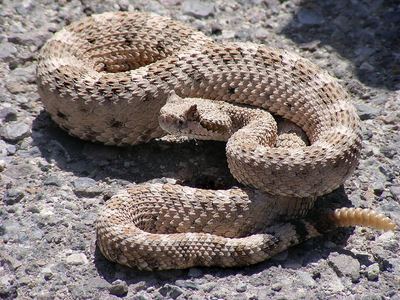
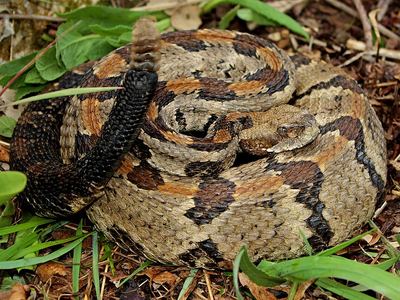
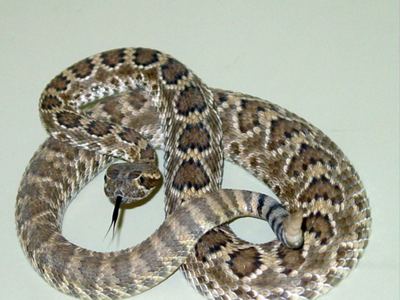
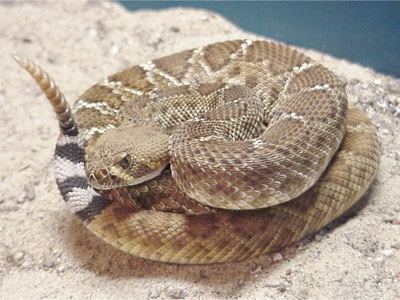
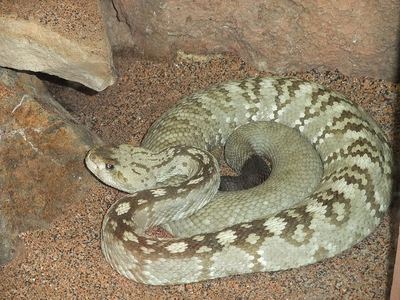
Eastern black-tailed rattlesnake (Crotalus ornatus)
The eastern black-tailed rattlesnake is a venomous pit viper in the family Viperidae. GBIF holds 459 licensed U.S. records of it; it reaches our listing threshold in 2 states, most of all Texas (394) and New Mexico (65). Its observation records peak in August.
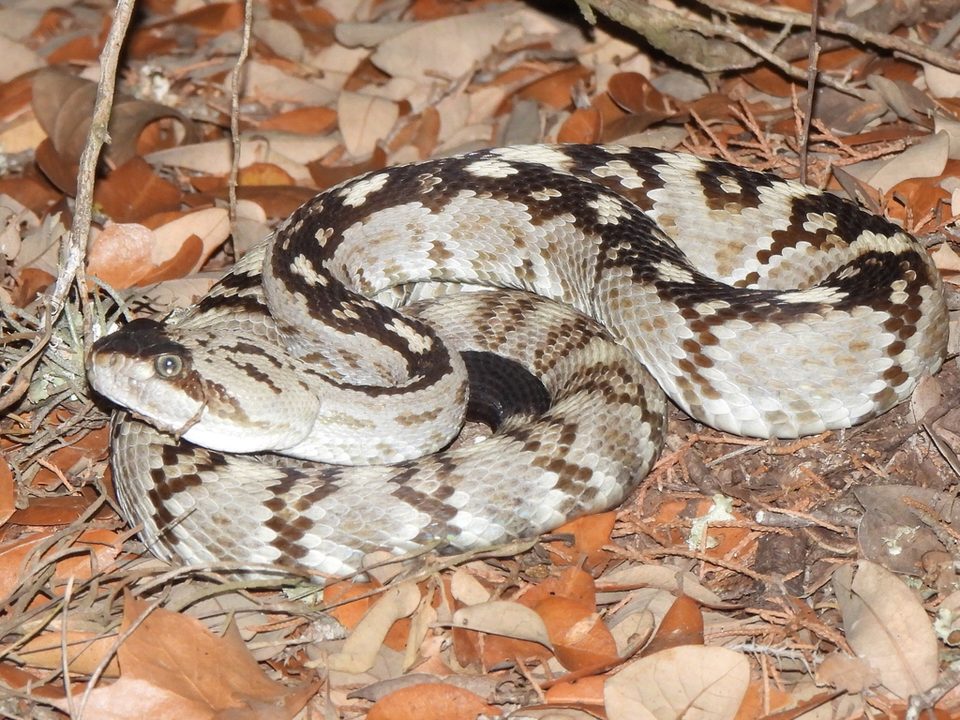
Is the eastern black-tailed rattlesnake poisonous or venomous?
Yes. The eastern black-tailed rattlesnake is a pit viper (family Viperidae), like every rattlesnake, copperhead and cottonmouth in the U.S. Its bite needs emergency care: call 911 and keep the bitten limb still. Antivenom is given in hospital.
Snakes often mistaken for it
Species commonly confused with rattlesnakes and recorded in the same states: gopher snake (recorded in all 2 of its states), Great Plains rat snake (recorded in all 2 of its states), plains hog-nosed snake (recorded in all 2 of its states) and eastern hog-nosed snake (recorded in 1 of its 2 states).
Which states have the eastern black-tailed rattlesnake?
The eastern black-tailed rattlesnake's U.S. record is concentrated: Texas alone holds 86% of licensed records. It is listed in 2 states in all; the next are New Mexico (65).
The count includes 191 records filed under the older name Crotalus molossus in Texas.
| # | State | Records | Share of state snakes | Rank in state |
|---|---|---|---|---|
| 1 | Texas | 394 | 1.0% | 29th of 86 |
| 2 | New Mexico | 65 | 1.0% | 20th of 56 |
When is the eastern black-tailed rattlesnake seen?
Across the U.S., observation records of the eastern black-tailed rattlesnake run mostly May through November, peaking in August with 23% of them. Almost none are from December to February.
Season by state
Among states whose main season falls within one calendar year, it starts earliest in April (Texas) and latest in May (New Mexico). Each of these states peaks in a different month: August in Texas and September in New Mexico.
| State | Main season | Peak month | Observation records |
|---|---|---|---|
| Texas | April through October | August | 71 |
| New Mexico | May through October | September | 38 |
Where the eastern black-tailed rattlesnake is recorded in each state
Texas
Texas holds 394 licensed records, the 29th most recorded of 86 snakes listed there. Its observation records in Texas run mostly April through October, peaking in August; most licensed records come from Brewster County, Jeff Davis County and El Paso County. Next come Hudspeth County (33) and Presidio County (30).
New Mexico
New Mexico holds 65 licensed records, the 20th most recorded of 56 snakes listed there. Its observation records in New Mexico run mostly May through October, peaking in September; most licensed records come from Doña Ana County, Sierra County and Otero County. Next come Socorro County (7) and Eddy County (5).
Top counties in the U.S.
| # | County | State | Records | Share of U.S. |
|---|---|---|---|---|
| 1 | Brewster County | Texas | 90 | 19.6% |
| 2 | Jeff Davis County | Texas | 73 | 15.9% |
| 3 | El Paso County | Texas | 66 | 14.4% |
| 4 | Hudspeth County | Texas | 33 | 7.2% |
| 5 | Presidio County | Texas | 30 | 6.5% |
| 6 | Culberson County | Texas | 24 | 5.2% |
| 7 | Doña Ana County | New Mexico | 17 | 3.7% |
| 8 | Terrell County | Texas | 16 | 3.5% |
| 9 | Pecos County | Texas | 13 | 2.8% |
| 10 | Val Verde County | Texas | 12 | 2.6% |
| 11 | Sierra County | New Mexico | 11 | 2.4% |
| 12 | Otero County | New Mexico | 10 | 2.2% |
| 13 | Socorro County | New Mexico | 7 | 1.5% |
| 14 | Crockett County | Texas | 7 | 1.5% |
| 15 | Eddy County | New Mexico | 5 | 1.1% |
How recent are the eastern black-tailed rattlesnake records?
The eastern black-tailed rattlesnake record leans on older material: only 21% of dated U.S. records come from 2017–2026, and the median record is from 1989. The oldest dated record is from 1860; the busiest year was 1972, with 19 records.
| Decade | Records | Share |
|---|---|---|
| 1860s | 1 | 0.2% |
| 1900s | 1 | 0.2% |
| 1910s | 4 | 0.9% |
| 1920s | 4 | 0.9% |
| 1930s | 20 | 4.6% |
| 1940s | 14 | 3.2% |
| 1950s | 30 | 6.8% |
| 1960s | 29 | 6.6% |
| 1970s | 68 | 15.5% |
| 1980s | 60 | 13.7% |
| 1990s | 29 | 6.6% |
| 2000s | 28 | 6.4% |
| 2010s | 90 | 20.5% |
| 2020s | 60 | 13.7% |
Species recorded in the same counties
Of the 33 counties where the eastern black-tailed rattlesnake is most recorded, 27 are also top counties for the gopher snake, more than for any other snake.
| Species | Shared counties |
|---|---|
| Gopher snake | 27 |
| Chihuahuan night snake | 24 |
| Eastern patch-nosed snake | 21 |
| Striped whipsnake | 21 |
| Long-nosed snake | 20 |
| Rock rattlesnake venomous | 20 |
| Chihuahuan hook-nosed snake | 18 |
| Coachwhip | 18 |
Related species in the U.S.
Other species of the genus Crotalus with profiles here: Western rattlesnake, Western diamondback rattlesnake, Prairie rattlesnake, Sidewinder, Timber rattlesnake, Mohave rattlesnake, Red diamond rattlesnake and Black-tailed rattlesnake.
GBIF records read 2026-09-29. Listed: any license. Counted: CC0/CC BY only. How we count.