Greater leucauge (Leucauge argyra)
The greater leucauge is a spider in the family Tetragnathidae that is not dangerous to people. GBIF holds 516 licensed U.S. records of it; it reaches our listing threshold in 1 state, most of all Florida (514). Its observation records peak in December.
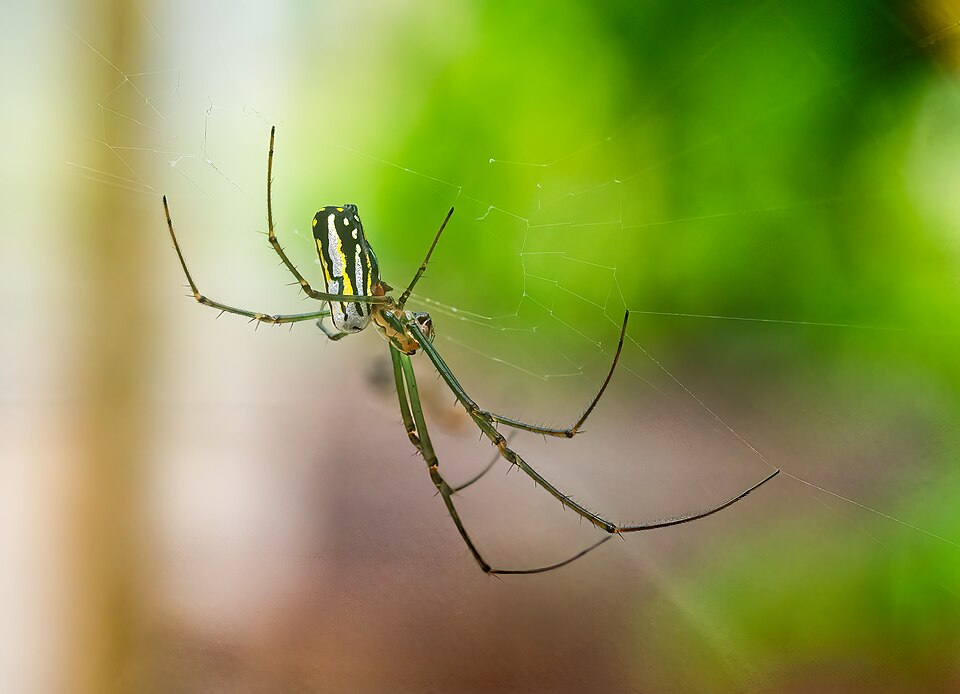
Leucauge argyra is a spider found in North, Central and South America (from United States to Brazil and the Caribbean). Leucauge argyra (and many other Leucauge spp.) is known to be a colonial species, with spiders maintaining individual territories/orb webs within a scaffolding of shared support lines maintained by the group. Colonies of multi-generational individuals are often seen with some levels of size stratification (where larger individuals/adults occupy the highest web positions and smaller individuals/juveniles occupy lower web positions).
From Wikipedia: Leucauge argyra, text under CC BY-SA 4.0.
Is the greater leucauge poisonous or venomous?
Not in any medically significant way. Like almost all spiders the greater leucauge (family Tetragnathidae) has venom for its prey, but it is not a widow or recluse, the two U.S. groups whose bites need medical attention.
Which states have the greater leucauge?
All listed records come from a single state, Florida, with 514 records.
| # | State | Records | Share of state spiders | Rank in state |
|---|---|---|---|---|
| 1 | Florida | 514 | 4.1% | 4th of 237 |
When is the greater leucauge seen?
Across the U.S., observation records of the greater leucauge run through most of the year, peaking in December with 14% of them. Winter (December to February) holds 35% of them.
How recent are the greater leucauge records?
Most of what is known about the greater leucauge is recent: 88% of dated U.S. records were made in 2017–2026, and half date from 2021 or later. The oldest dated record is from 1934; the busiest year was 2025, with 76 records.
| Decade | Records | Share |
|---|---|---|
| 1930s | 2 | 0.4% |
| 1950s | 1 | 0.2% |
| 1980s | 1 | 0.2% |
| 2000s | 1 | 0.2% |
| 2010s | 166 | 31.3% |
| 2020s | 360 | 67.8% |
Species recorded in the same counties
Of the 15 counties where the greater leucauge is most recorded, 11 are also top counties for both the gray wall jumper and the tropical orb weaver; no other spider shares more. None of its closest neighbors is venomous.
| Species | Shared counties |
|---|---|
| Gray wall jumper | 11 |
| Tropical orb weaver | 11 |
| Box spider | 10 |
| Global tentweb weaver | 10 |
| Huntsman spider | 10 |
| Leucauge argyrobapta | 10 |
| Spiny-backed orbweaver | 10 |
| American golden orb weaver | 9 |
Related species in the U.S.
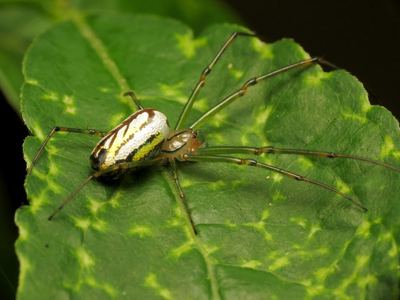
Other species of the genus Leucauge with profiles here: Orchard orbweaver.
.jpg)
GBIF records read 2026-09-29. Listed: any license. Counted: CC0/CC BY only. How we count.