Common west coast woodland spider (Cybaeus reticulatus)
The common west coast woodland spider is a spider in the family Cybaeidae that is not dangerous to people. GBIF holds 1,218 licensed U.S. records of it; it reaches our listing threshold in 2 states, most of all Alaska (1,213) and Washington (5). Its observation records peak in August.
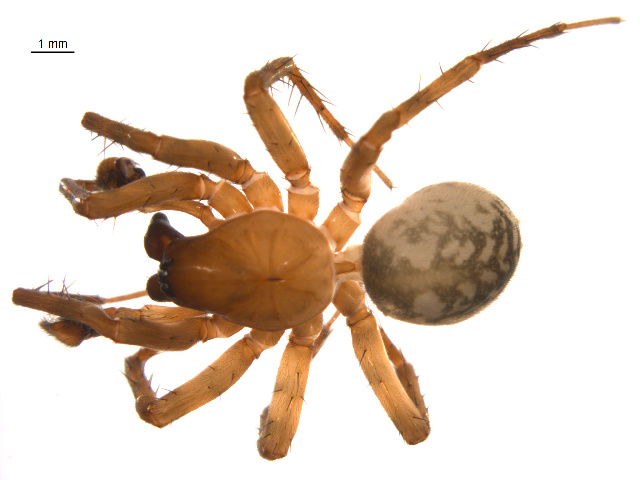

Cybaeus reticulatus is a species of true spider in the family Cybaeidae. It is found in the United States and Canada. It was first described by Eugène Simon.
From Wikipedia: Cybaeus reticulatus, text under CC BY-SA 4.0.
Is the common west coast woodland spider poisonous or venomous?
Not in any medically significant way. Like almost all spiders the common west coast woodland spider (family Cybaeidae) has venom for its prey, but it is not a widow or recluse, the two U.S. groups whose bites need medical attention.
Which states have the common west coast woodland spider?
The common west coast woodland spider's U.S. record is concentrated: Alaska alone holds 100% of licensed records. It is listed in 2 states in all; the next are Washington (5).
| # | State | Records | Share of state spiders | Rank in state |
|---|---|---|---|---|
| 1 | Alaska | 1,213 | 4.7% | 1st of 280 |
| 2 | Washington | 5 | 0.1% | 76th of 157 |
When is the common west coast woodland spider seen?
Across the U.S., observation records of the common west coast woodland spider run mostly May through August, peaking in August with 37% of them. Almost none are from December to February.
How recent are the common west coast woodland spider records?
The common west coast woodland spider record leans on older material: only 0% of dated U.S. records come from 2017–2026, and the median record is from 2010. The oldest dated record is from 1963; the busiest year was 2010, with 360 records.
| Decade | Records | Share |
|---|---|---|
| 1960s | 3 | 0.2% |
| 1970s | 63 | 5.2% |
| 1980s | 4 | 0.3% |
| 1990s | 10 | 0.8% |
| 2000s | 203 | 16.8% |
| 2010s | 922 | 76.4% |
| 2020s | 2 | 0.2% |
Species recorded in the same counties
Of the 11 counties where the common west coast woodland spider is most recorded, 11 are also top counties for both the Miller dwarf weaver and Sisicottus nesides; no other spider shares more. None of its closest neighbors is venomous.
| Species | Shared counties |
|---|---|
| Miller dwarf weaver | 11 |
| Sisicottus nesides | 11 |
| Callobius pictus | 10 |
| Grey sheetweb weaver | 10 |
| Pocadicnemis pumila | 10 |
| Common six-spotted cobweaver | 9 |
| Halorates alascensis | 9 |
| Hilltop wolf spider | 9 |
GBIF records read 2026-09-29. Listed: any license. Counted: CC0/CC BY only. How we count.